
 2 months ago
68
2 months ago
68
ARTICLE AD BOX
14 minutes ago
Francesca OsborneBBC West Investigations

 BBC
BBC
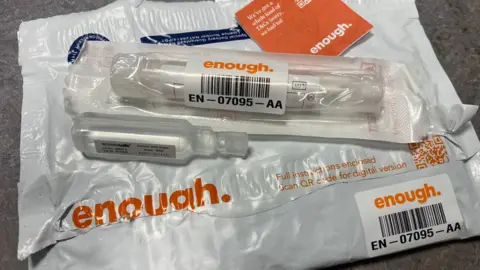
This kit contains a swab, a vial of water, a plastic tube and instructions
A company issuing self-swab DNA testing kits to sexual assault victims has had online posts banned for containing misleading information.
The Advertising Standards Authority (ASA) ruled that Enough's website, LinkedIn post and GoFundMe page made unproven claims about how evidence from their kits could be used in court and how many women were raped in the UK each year.
Sir Martin Narey, the former head of the Prison and Probation Services in England and Wales who brought the complaint about the adverts, said: "I thought they were frightening young women and terrifying their parents by exaggerating the likelihood of being raped."
Miles Lockwood from the ASA said the posts were banned for lacking evidence. In a statement, Enough said it respected the ASA's ruling and had updated its wording.
However, he said he had started to become increasingly concerned the company may be "exaggerating" claims.
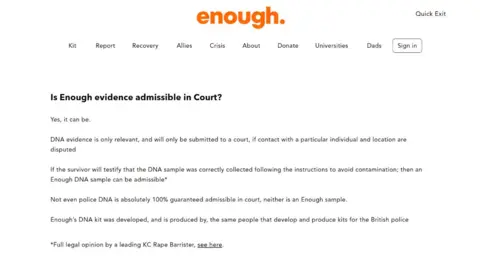
The ASA found the website made claims that added to the impression that the kits would lead to securing the prosecution of perpetrators if used and handled properly
Enough, which launched in Bristol, said a woman was twice as likely to be raped as diagnosed with cancer and inflated figures published by the Office for National Statistics (ONS) on the number of rapes that happen in the UK each year.
ONS figures show 71,227 rapes were reported to the police in 2024, but Enough said the figure could be substantially higher based on the number of incidents not reported.
"The thing that worried me much more than that were the claims about the likely admissibility of the self-swab kits," said Narey.
"The awful truth is that young women and parents have bought these kits in the hope that it might help in the awful event of their daughter being harmed.
"They hope that that might bring someone to justice. It's likely to do the reverse."
Enough started handing out the kits to Bristol students free of charge last year and has also been selling them online for £20.
The premise behind the tests is to allow people who think they have been sexually assaulted to take a swab at home and get it tested for the DNA of an alleged perpetrator and have the results stored.
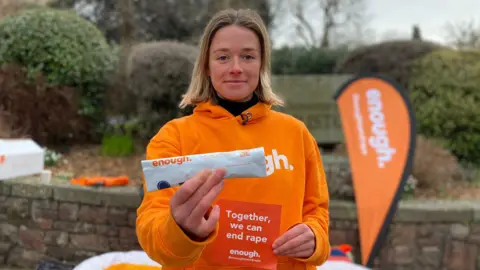
Katie White is the co-founder of Enough, which she started with Tom Allchurch
The Faculty of Forensic and Legal Medicine issued a joint statement in September 2024 from a number of individuals and organisations, including clinicians, forensic scientists and the Forensic Capability Network.
It said it did not currently support the use of self-swab kits, adding they could "put survivors at risk" without the right information.
But at the time, Enough said the kits acted as a deterrent at a time of "intolerable levels of rape" and provided a route to report outside the criminal justice system.
What was challenged in the advertising ?
- Whether the evidence from Enough's testing kits being admissible in court was misleading and could be substantiated
- The figures reported in the advert of "430,000 rapes a year", "430,000 rapes in the UK last year" and "Over 400,000 women are raped every year"
- The statements that a "woman is twice as likely to be raped as be diagnosed with cancer" and "Our daughters are twice as likely to be raped than get cancer"
The ASA upheld all three of the complaints and all of the adverts have now been banned.
The company has been ordered to not state or imply that evidence gathered using its self-testing kits is admissible in court unless it holds adequate substantiation for those claims.
Enough was further told not to make claims regarding the incidence of rapes or the number of women raped unless it holds adequate substantiation for those claims.
Miles Lockwood, director of Complaints and Investigations at the ASA, said: "The problem with these adverts was that Enough gave an impression that you could have more confidence in the reliability of the DNA evidence you would collect through these test kits than was actually the case.
"They didn't have the evidence to make the claims that were in the ad, and that's why we banned them."
He added: "Ultimately, what's happening here is that they're promoting DNA self-test kits for women who have experienced a truly traumatic event so we expect to have really high levels of evidence if you're making a claim like that."
In a statement, Enough said it "respects" the ASA's ruling and had updated its wording to ensure greater clarity.
"Following the complaint, we have been in discussions with Committees of Advertising Practice and our wording now reflects their language guidance," a spokesperson said.
Enough said its wording on the number of rapes a year in the UK now referred to the "estimated" number, and that its kits "can in principle be admissible in court".
They went on to say that the company was created to address the "do nothing gap" for those who do not report to the police or sexual assault referral centres, but that that it has always been clear that these "remain the best and most comprehensive option where survivors feel able to access them".
- If you have been affected by the issues in this article, help and support can be found at BBC Action Line


 English (US) ·