
 3 months ago
78
3 months ago
78
ARTICLE AD BOX
30 minutes ago
Nadine YousifSenior Canada reporter

 Getty Images
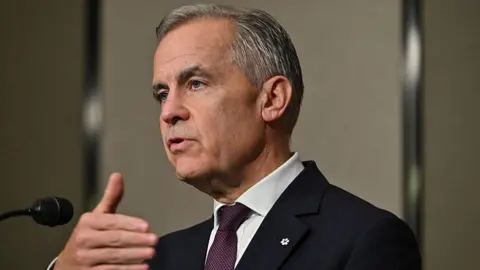
Prime Minister Carney says Canada is ready for "detailed negotiations" with the US, but is "also ready to wait" if necessary.
Prime Minister Mark Carney said that US liquor could return to Canadian shelves if tariffs on metals and automobiles are addressed, as public rhetoric on trade talks between the two countries heats up.
"Issues such as decisions on which alcohol to put on the shelves - we can make progress very quickly on that with progress in other areas," Carney said on Thursday.
US Commerce Secretary Howard Lutnick on Wednesday said the liquor ban by most Canadian provinces was "disrespectful", while US Trade Representative Jamieson Greer warned of consequences if the issue is not resolved.
Canadian provinces brought in the booze bans in response to tariffs placed from the Trump administration.
They include Ontario, whose liquor control board is one of the largest buyers of alcohol in the world, which removed US-made alcoholic drinks from shelves in March 2025.
It came in retaliation for tariffs imposed by Trump, including on key Canadian sectors like steel, aluminium, automobiles and agricultural products, which Trump argues boost US manufacturing and jobs.
Carney said that these tariffs are a violation of a standing free trade agreement between Canada, the US and Mexico, called the USMCA.
He added that Canada is prepared to enter "detailed negotiations" with the US on the future of North American free trade, but is "also ready to wait if that's what has to happen".
The US has laid out a number of trade irritants with Canada, which include alcohol and access to the dairy market.
The back and forth comes as Canada, the US and Mexico are staring down a deadline of 1 July for a mandatory review of the USMCA.
"There's two parties in a negotiation," Carney told reporters on Thursday. "We're not sitting here taking notes and taking instruction from the US."
It is up to the provinces to decide if they want to sell US alcohol again, as liquor sales in most Canadian jurisdictions are regulated by the province, not the federal government.
Ontario Premier Doug Ford has been steadfast in his position that the booze will not go back on the shelves in provincial stores until these sector-specific tariffs are dropped.
Speaking to CNN on Thursday, Ford said the American economy is losing "tens of billions of dollars" as a result of Canadians boycotting the US, including avoiding travel south.
"This can come to a quick end, everyone can thrive and prosper," Ford said, if tariffs are lifted.
Trump's sector-specific tariffs have especially hurt Ontario - the heartland of Canada's auto sector, and where thousands have jobs have already been lost.
Candace Laing, the president and CEO of the Canadian Chamber of Commerce, said that while Canada has "red lines" it is not willing to concede in talks, it is open to using alcohol as "leverage" as it seeks reductions from the US on sector-specific tariffs.
"Canada is not going to give any concessions that aren't in the context of a real negotiation," said Laing, who was appointed this week by Carney to his new Canada-US trade advisory committee,
Canada's negotiating position improved in recent months, argued Fen Hampson, a professor at Carleton University in Ottawa and a co-chair of its expert group on Canada-US relations.
Trump's political position is "eroding" as the US and Israel war on Iran continues to be unpopular with Americans, a factor that could affect who controls Congress after the US midterm elections later this year, he said.
Last week, Lutnick dismissed the position that Canada stands to benefit by waiting for pressure on Trump to intensify, calling it "the worst strategy I've ever heard", and noting the size of the US economy dwarfs Canada's.
Hampson disagreed, arguing there is a benefit in waiting to see what deal Trump carves out with Mexico and other countries.
"There's a last mover advantage, in the sense that you see what everybody else has."
Canada also has goods that the US needs, like metals, energy and critical minerals, he added.
"The Canadians are very smart here," Hampson said. "They're ragging the puck, they're running the clock down."






 English (US) ·