
 1 month ago
51
1 month ago
51
ARTICLE AD BOX
10 minutes ago
Daniel O'Donoghueand William Higgens,North West Investigations

 BBC
BBC
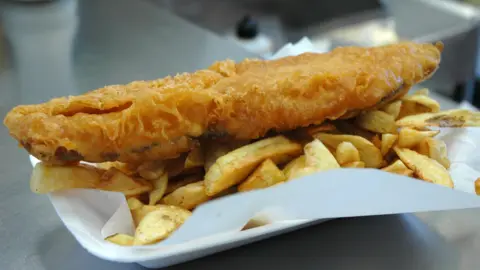
A type of tropical freshwater catfish found on sale in the north-west of England is usually farmed and imported from South East Asia and is markedly cheaper than cod
Rogue chip shops have been passing off catfish as "traditional fish and chips" to cut down on costs, the BBC has learned.
Cases of fish being mis-sold or misdescribed are often hard to detect since any investigations are intelligence-led and rely on expensive DNA testing.
A BBC North West investigation found a catfish species, known as pangasius or river cobbler, being sold in the region's chippies without customers being fully aware of what they were buying.
The Chartered Trading Standards Institute said that while the mis-selling or misdescription of fish was not a widespread issue it acknowledged "there are still some unscrupulous businesses".
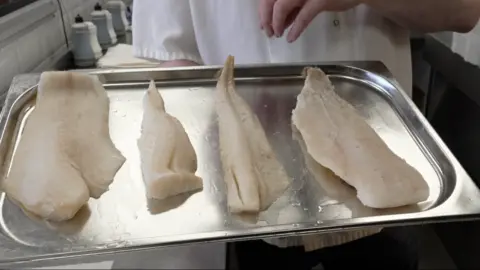
To the untrained eye, fish fillets can be hard to tell apart
Catfish, which is safe to eat, is generally farmed and imported from South East Asia.
It is significantly cheaper, at about £3.40 per kilogram wholesale, than traditional species such as cod and haddock which typically go for £15 per kilogram.
The investigation was prompted by the owner of a Liverpool chip shop contacting the BBC to complain about the dishonest practice.
"This goes on more than you'd think and it's putting people like me at a disadvantage," he said.
The BBC analysed dozens of online food reviews in which customers questioned the species of fish that they had bought.
Many of them left comments such as "haven't a clue what type of fish it was" and "not cod or haddock, some cheap white fish".
The reviews led the BBC to identify 10 businesses, five in Liverpool and five in Manchester, for a sample test.
Three of the chip shops that our reporter visited listed cod on the menu, four listed haddock and three listed just "fish".
If asked, a business is legally obliged to inform a customer of the species.
The three which did not list a species told the BBC they were "normal fish" or "white fish".
In one case the server gestured to a sign which said "traditional fish and chips".

Professor Stefano Mariani of Liverpool John Moores University says DNA sampling of fish is rarely done by local authorities
DNA testing at Liverpool John Moores University revealed that all three takeaways had sold catfish.
Professor Stefano Mariani, who oversaw the tests with his colleague Catherine Perfect, said: "We used DNA barcoding to identify the species, and we found three out of the 10 samples were pangasius - often known as river cobbler on the market, a type of tropical freshwater catfish."
Mariani told the BBC: "In my experience with fish and chips, three out of 10 is quite a lot - I don't recall seeing this level of catfish."
The portions of catfish were bought for £3.80, £4.20 and £5.
Servings of cod or haddock were sold for between £4 and £6.
Asked whether a customer could tell the difference, Mariani said: "It is very difficult for a member of the public that is not a trained fish biologist to identify one fillet from another."
National Trading Standards told the BBC that fish being sold under the wrong name was a "food labelling issue".
It said it would be the responsibility of the Food Standards Agency (FSA) to investigate.
The FSA advised that local authorities would likely lead on isolated cases of fish and chip shops misselling items.
The BBC contacted every local authority in the North West, of which 10 did not respond and 11 were either "not aware" of fish fraud as an issue or did not have any ongoing investigations.
Salford Council said it had issued a warning to a trader after finding a different type of fish being sold as cod.
A spokesman added: "We have not received any recent complaints but would urge people to share any information relating to concerns in Salford so we can review and assess them."

Chip shop owner Andrew Crook, who has sold farmed fish species, said customers must be properly informed about what they are buying
Much like in the 2013 horsemeat scandal, eating cheaper fish does not present a health risk, but concerns have been raised about consumer deception.
"It probably does go on," said Andrew Cook, president of the National Federation of Fish Friers.
The Lancashire businessman, who runs a chip shop in Chorley, has been in the business for almost 30 years.
He said: "I was only talking to somebody the other day who went into a pub and ordered fish and chips and he thought it was pangasius and when he tackled them about it, they said it was.
"It is fine to eat, there's nothing wrong with it, but when you go and get fish and chips most people expect a marine species, so cod, haddock or plaice.
"I think if you've got something that's farmed, like pangasius, as long as it's advertised as such that's fine.
"It's when it's being sold at a cod price that's a problem and shops need to be careful about doing that."
Crook urged chip shops to list the species on their menus, adding: "As an industry, we've got to have the trust of the general public."

Steven Booth, queuing for his lunch, said people should be more open to trying non-traditional types of fish
Steven Booth, 41, who was waiting in Crook's chippy to buy his lunch, said: "My wife is from Thailand and over there catfish is often on the menu, it's fantastic and I'm up for trying it, but it's incredibly important you are told what you're eating."
Linda Williams, 66, added: "If I order fish and chips, I'd probably expect to get cod or haddock. I wouldn't be happy if I paid for cod and I was sold something else, it should be what is advertised."

Linda Williams said she would demand a refund if she suspected she had been sold a different type of fish than what had been advertised.
Chris Jones, 68, who always orders cod and chips, said: "I have heard rumours of chip shops selling catfish.
"I wouldn't be against trying it but places shouldn't be passing it off as cod and charging that price."
Dean Cooke, food lead officer at the Chartered Trading Standards Institute, said: "We would advise, in instances where the fish species is not specified, for consumers to request this information from the business.
"If they are not convinced that they are being told the truth, or that they feel that information is being withheld, they should contact their local trading standards or environmental health team."





 English (US) ·