
 4 months ago
84
4 months ago
84
ARTICLE AD BOX

 The Fun of Travel (thefunoftravel.com)
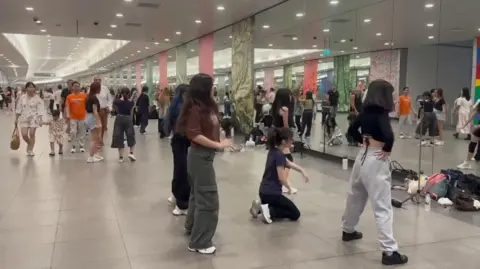
Before the mirrors were frosted, aspiring dancers practised in front of them most days
With its wide floors, floor-to-ceiling mirrors and a ready audience, the underground passage connecting a train station to Singapore's iconic Gardens by the Bay had served as a practice ground for aspiring dancers for years.
Until 1 January, when they showed up as usual only to find the mirrors frosted.
Hundreds of commuters and tourists walk through the spacious tunnel every day, many of them on their way to the city's number-one attraction. People had complained that the dancers were "blocking pedestrian flow at this high-traffic area", local media reported.
So, the mirrors were frosted, triggering a debate – not just about space, but also Singapore's fixation with orderliness, the low bar for people to complain, and its many, many rules.
All of which arguably stifle the abandon, or even the havoc, that is often characteristic of the world's biggest cities.
This is not the first time Singaporeans have crossed swords over how common spaces should be used in the land-scarce country, where more than 8,300 people jostle for each kilometre.
From whether frisbees should be allowed in parks, to benches fitted with dividers to deter rough sleepers, Singaporeans are often split on whose needs come first.
Additional restrictions are not the problem, says urban planning expert Tan Shin Bin from the National University of Singapore.
"[What should] give us pause is really whether the decision was a well-considered and fair one... Whose needs are being prioritised as legitimate, and whose desires are deemed secondary?"
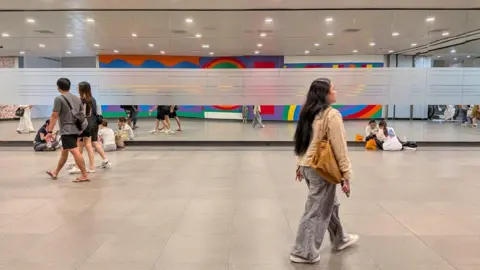 Kelly Ng/BBC
The mirrors were frosted after complaints dancers were "blocking pedestrian flow"
In the case of the walkway, it is one of many owned and maintained by private developers to "facilitate all-weather, safe and convenient connectivity", authorities told the BBC.
This particular one belongs to Marina Bay Sands (MBS), the luxury hotel, casino and mall hard to miss in the city's towering skyline.
But their decision to frost the mirrors stirred a debate because the walkway is used by so many people, not just those making their way to MBS.
Singapore's urban planning authority said MBS had lined the path with mirrors "to enhance the visual appearance and experience", but the "primary function" is for walking.
Some Singaporeans said the dancers in the walkway were inconsiderate, as they would sometimes block the path with props. "If they had kept to one side, no-one would have complained," read a comment on Instagram with more than 3,000 likes.
Others pushed back, calling the move to frost the mirrors "blunt" and "rigid". Several said they enjoyed watching the dancers while passing through and sympathised with them because the cost of renting a studio was so high.
"Seeing other dancers around me was really motivating," says Wilson Tay, who used the walkway for dance practice twice a week. "It was also fun when tourists stopped by and tried to mimic my moves."
Now there are no catchy K-pop beats and lingering onlookers who groove along.
Some dancers, like Tay, now practise at a train station two stops away, where five full-length mirrors have been put up in a corner, carefully marked with yellow tape.
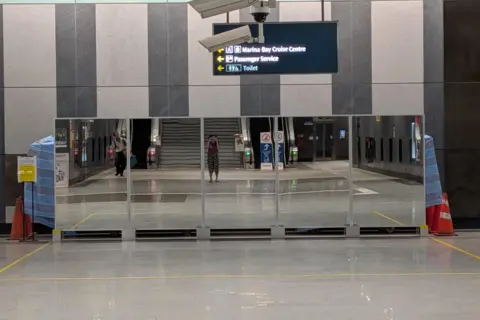 Kelly Ng/BBC
Tay and other dancers now practise in this corner of a quieter train station that is close by
"It is very quiet here and much less vibrant. I've often found myself practising alone," Tay says. "But the good thing, I guess, is that I get to dance without being disrupted."
In so many cities, dancing, skateboarding and other activities in public places become a part of the daily rhythm, as people adjust to what is happening around them, whether they see it as artistic expression, or a nuisance.
But this is Singapore, a nation built on pragmatism, order and convenience.
Well-planned or over planned?
Efficient urban planning has transformed what was once an island of fishing villages into a gleaming metropolis of high-rises. Public transport connects almost every corner of this tiny country, lush greenery lines the highways and spills out of towering buildings and courtyards, while the pavements are wide, often sheltered, and free of litter.
Singapore's founding prime minister Lee Kuan Yew attributed this swift, impressive change to "efficient administration".
"There's a definite plan, and we stuck with the plan. There is no corruption and nobody can deviate from the plans. A building that is not in accordance with the plan cannot be allowed," Lee said in an interview in 2012.
Urban design today largely rests in the hands of state agencies because long-term foresight and expertise are crucial for properly using scarce land.
They are guided by a key document called the Concept Plan, which charts out Singapore's land use needs half a century into the future. Medium-term plans are reviewed every five years.
For PM Lawrence Wong, Singapore's orderly nature is a competitive advantage.
"We are boring, and we will never have the same offerings as New York and Paris," he told a conference in July. "But at the same time, we are stable, we are predictable. We are reliable and we are trusted, and these are intangible assets that others would die to have."
This top-down control over urban development has drawn both envious admiration and criticism.
"You have the second densest country in the world, that has virtually uncongested streets," Harvard economist Edward Glaeser said of the city-state.
"Americans visiting Singapore can be forgiven for wistfully wondering why our own cities don't seem so well-managed," he wrote in his book Triumph of the City.
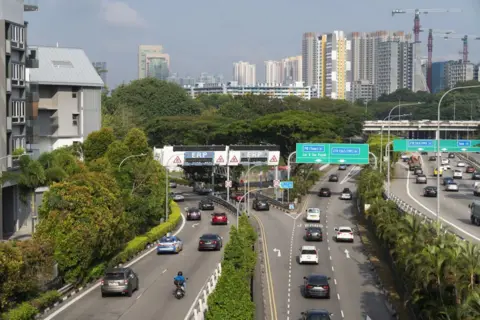 Bloomberg via Getty Images
Singapore's organisational skills have earned both admirers and critics
Dutch architect Rem Koolhaas is less enthusiastic.
Singapore is managed in a way that "excludes accident and randomness", he wrote in Singapore Songlines, his seminal essay on the city's rapid makeover.
"It is pure intention: if there is chaos, it is authored chaos: if it is ugly, it is designed ugliness; if it is absurd, it is willed absurdity."
The Singapore government has embraced such organised chaos.
They have launched a Lively Places Fund that gives residents up to S$20,000 ($15,800; £11,600) to "activate and create more interesting and fun public spaces in [their] neighbourhood".
The national transport operator has also set aside specific spots in some train stations for dancers to practise.
But some Singaporeans wish authorities would leave more room for spontaneity.
"We shouldn't let the small size limit our thinking of what our city can be," Singaporean writer Justin Zhuang says. "If we want Singapore to be a diverse city, we should also accept that there would be diverse activities."
Authorities acknowledge this. "As Singapore becomes denser, shared public spaces will increasingly need to accommodate diverse users and activities," the urban planning authority told the BBC.
But they added that "this requires both thoughtful design and shared stewardship", and while "property owners play a role in managing shared spaces", so do users "by being mindful of how their activities may affect others".
Zhuang believes "there must be a way to compromise" without one group prevailing at "the expense of the other". But who will broker that compromise?
In most other cities, where some amount of chaos is normal, local officials are likely to be less involved in every fight over public space. So residents manage conflicts by themselves. In Singapore, people often look to the state to intervene.
Although the city is packed with skyscrapers, residents live alongside, or not too far from parks, tree-lined highways and roof gardens.
Trees and plants are well-manicured: officials prune, shape and clear the shrubs regularly, and parks are governed by an elaborate rulebook that includes bans on activities like cycling, skating and kite-flying, depending on the park.
Graffiti, seen as a form of creative expression in so many cities, is also illegal in Singapore. Offenders can be fined, jailed and caned. The murals that do exist are commissioned by authorities.
And then there are some activities, like busking, that are allowed only at designated spots, and aspiring performers must pass auditions judged by a panel from the National Arts Council.
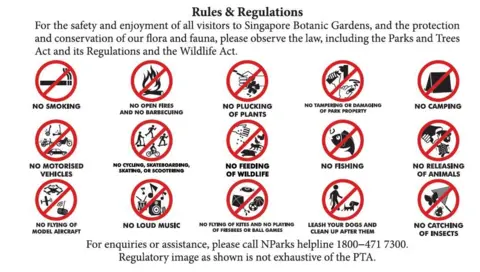 National Parks Board
Singapore's public spaces are governed by an elaborate rulebook
Singaporeans enjoy the comforts and protections of life in a well-regulated society, but some say the expectation that the state should "fix" problems has fostered a culture of complaining. There are even Facebook groups where people air their daily grievances. Noise disputes between neighbours are common; some have turned deadly.
"If Singapore is a nanny state, then I'm proud to have fostered one," Lee Kuan Yew famously wrote in one of his books.
His son and former PM Lee Hsien Loong told CNBC: "If you ask the Singaporeans, on the one hand, they'll say let us do our own thing, on the other hand, whenever an issue comes up, they'll ask what the government is doing about it."
Most recently, complaints around the staccato beat from pickleball games prompted local authorities to shorten court hours and put out noise reminders. In one neighbourhood, they turned off lights earlier to prevent late-night games.
In 2016, officials installed metal railings at an open space on the ground floor of a public housing block – known in Singapore as a "void deck" – in response to complaints about people playing football there.
Ball games are noisy and can dirty or damage the space, the local council said, but some questioned whether the barricades were necessary.
"[This] space, originally filled with so much potential for use and creativity, is now effectively transformed into a dead space," a resident told local newspaper The Straits Times.
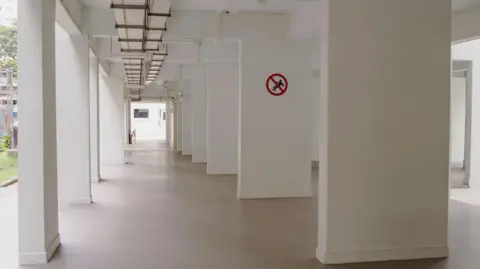
Void decks were initially built for ventilation and to prevent floods, before evolving into spaces where residents exercise, play games and hang out. But safety concerns over the years have led to bans on rollerblading and ball games.
 Getty Images
A void deck in a public housing block
When Wong Kae Chee decided to start a community library in the void deck in her apartment building in 2022, she was nervous.
"I brought one bookcase down to the void deck in the middle of the night. I was concerned about whether people would catch me doing something I was 'not supposed' to be doing."
As Wong expected, the project ran into roadblocks with local authorities, who were concerned the library was a "fire hazard" and objected to volunteers bringing in their own furniture.
"One time, town council officers approached us as we were installing minor fixtures and went, 'You think this is your house?'
"I said, 'Yes! We all live in the block of flats above this library.' What's wrong with making good use of a space that would otherwise be left empty, as it has been for years?"
As Wong and her team fought back, residents continued frequenting the space, donating their own books, tables and benches.
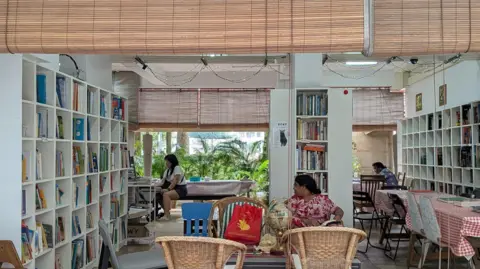
Today, the volunteer-run library features more than 7,000 titles across 14 languages, musical instruments that visitors are free to use, as well as a playpen for the community cat. It is also used to host group singing sessions, weekly dinners and sometimes doubles up as an "IT helpdesk" for elderly residents.
"This is more than just a little library," reads a colourful sign at the entrance.
 Kelly Ng/BBC
Wong has turned the void deck at her flats into a community library







 English (US) ·