
 4 years ago
68
4 years ago
68
ARTICLE AD BOX
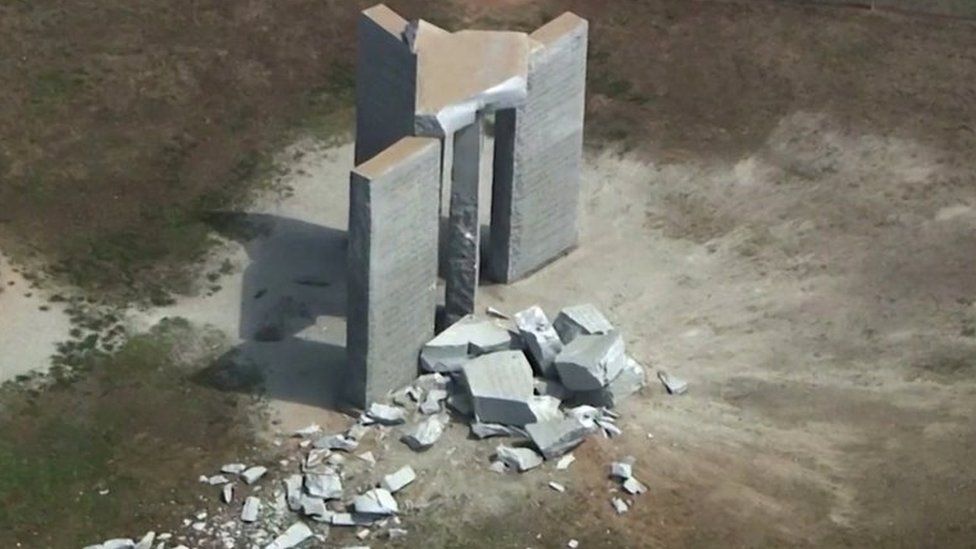 Image source, Reuters
The damaged monument was later completely demolished "for safety reason", Georgia's state authorities said
A granite monument in rural Georgia has been demolished for safety reasons after being damaged in a blast.
An explosion early on Wednesday reduced one of the slabs at the Georgia Guidestones to rubble.
CCTV footage showed a car leaving the scene and authorities are investigating.
Despite being built in 1980, the monument has been nicknamed "America's Stonehenge", a reference to the prehistoric landmark in the UK.
The 19ft-high (5.8m) structure near Elberton, east of Atlanta, was commissioned by a person or a group under the pseudonym RC Christian.
On 22 March 1980, the Georgia Guidestones weighing 119 tons, was revealed to a crowd of about 100 people.
One crowd member, a local pastor, immediately professed his belief that the stones were built for cult and devil worship because of its similar appearance to Stonehenge.
Watch: The moment explosions detonate at Georgia monument
On each side of the capstone, engraved in four ancient languages - Babylonian cuneiform, Classical Greek, Sanskrit and Egyptian hieroglyphic - were the words: "Let these be guidestones to an Age of Reason."
And written in eight languages - English, Russian, Mandarin Chinese, Arabic, Classical Hebrew, Swahili, Hindi and Spanish - were cryptic instructions for rebuilding society post Doomsday:
"Maintain humanity under 500,000,000 in perpetual balance with nature; Guide reproduction wisely - improving fitness and diversity; Unite humanity with a living new language; Rule passion - faith - tradition - and all things with tempered reason; Protect people and nations with fair laws and just courts; Let all nations rule internally resolving external disputes in a world court; Avoid petty laws and useless officials; Balance personal rights with social duties; Prize truth - beauty - love - seeking harmony with the infinite; Be not a cancer on the Earth - Leave room for nature - Leave room for nature."
The state tourist website ExploreGeorgia.org says the monument serves "as an astronomical calendar, and every day at noon the sun shines through a narrow hole in the structure and illuminates the day's date on an engraving".








 English (US) ·