
 3 months ago
85
3 months ago
85
ARTICLE AD BOX
Joshua Nevett,Political reporterand David Cornock,Parliamentary correspondent

 Getty Images
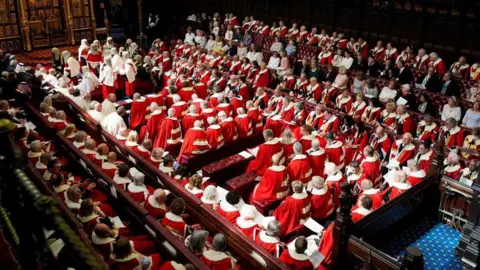
Dozens of hereditary peers are set to lose their seats in the House of Lords, after the passage of a bill that will end a parliamentary role dating back hundreds of years.
Peers passed the House of Lords (Hereditary Peers) Bill after ministers offered a compromise to end a long-running dispute with opponents of the reform.
The majority of hereditary peers, who inherit their titles through their families, were abolished in 1999 under the last Labour government and this bill gets rid of the last remaining 92.
Lords Leader Baroness Smith said the "historic legislation" realised Labour's manifesto pledge to remove the right of all hereditary peers to sit and vote in the upper house.
"This has never been about the contribution of individuals but the underlying principle that was agreed by Parliament over 25 years ago that no-one should sit in our Parliament by way of an inherited title," Baroness Smith said.
"Over a quarter of a century later, hereditary peers remain whilst meaningful reform has stagnated.
"We have a duty to find a way forward."
Baroness Smith confirmed the government would offer life peerages to some of the Conservatives and crossbenchers who would otherwise lose their seats.
As a result, the Conservatives withdrew their opposition to the bill.
Up to 92 hereditary peers will leave the Lords when the current session of Parliament ends, which is expected to be in May.
The Conservative leader in the Lords, Lord True, said he accepted the government's mandate to end hereditary membership of the upper house.
Confirming the Tories would no longer fight the bill, he said he had always believed there was a need to dial down "eternal [parliamentary] ping-pong" even though the compromise would be a bitter pill for some on his side to swallow.
In another compromise, the government also plans to increase the number of paid ministers in the Lords - some have worked without a salary due to restrictions in the current law.
One of the departing hereditaries, the Earl of Devon, said the bill was regrettable.
He said his family had been in the Lords for 900 years and complained the notice period was less than required in employment law.
"I think the public will miss us," the Earl of Devon said.
He added: "We should be proud to sit here as embodiments of the hereditary principle dating back a millennium."
Baroness Smith said interim measures had been in place for 25 years since the first hereditaries were removed under Tony Blair's government in the 1990s.
Ministers are looking at further reforms with a possible retirement age and minimum participation rates.
The bill is now set to become law.








 English (US) ·