
 2 months ago
66
2 months ago
66
ARTICLE AD BOX
29 minutes ago
Bushra MohamedBBC Africa, Minneapolis

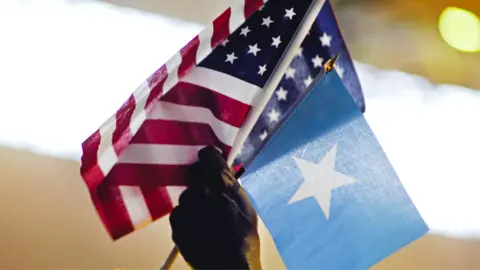 Washington Post via Getty Images
The US state of Minnesota has been home to a huge Somali diaspora community since the 1990s
Months after it was announced that the surge of immigration agents in Minnesota was coming to an end, fear still pervades parts of the US state.
The ongoing enforcement operation, which sparked nationwide protests after two US citizens were killed, has left some residents shaken - particularly among the largest Somali community outside Africa, found in the city of Minneapolis.
Abdi, a 23-year-old man from Somalia whose name has been changed to protect his identity, is one of those who lives in the shadows - terrified of the immigration agents still patrolling the city.
"It hasn't ended," Abdi told the BBC. He said he had been told by other members of the community that Immigration and Customs Enforcement (ICE) agents were still conducting raids on people's homes. "I don't know when they will show up at my house."
He explained that he rarely stays in one place for longer than five nights - and sneaks out to go to work. He said that some of his friends had been detained even though, like him, they had documents to prove their Temporary Protected Status (TPS).
This allows people from countries affected by conflict, disaster or extraordinary conditions to live and work legally in the US for a limited period.
At peak level, the deployment of agents in Minnesota was in the thousands, before Trump's border tsar Tom Homan announced a draw-down. In mid-February, he said only a "small" contingent would remain.
Many arrived in the years following the collapse of the last government to control the whole of Somalia in 1991. The country has since experienced chronic droughts and known little peace - and for the past two decades has been battling Islamist militants, in particular those from al-Shabab, a group aligned with al-Qaeda.
Abdi left Somalia in 2022 - fleeing after he says al-Shabab fighters tried to recruit him.
"I spent about $15,000 [£11,000] to get here. My family gave everything," he told me when I met him in March, speaking quietly from a dimly lit apartment hallway.
He bought a Kenyan passport from smugglers and flew to Brazil and there began his long journey towards the US across the Darién Gap, a stretch of jungle between Colombia and Panama, which is widely regarded as one of the world's most perilous migration routes.
"At one point I stepped on a dead body," he said.
After reaching the US-Mexico border, he crossed into the US and applied for asylum. On legal advice, he also applied for TPS, which allowed him to live and work in the country until 2029.
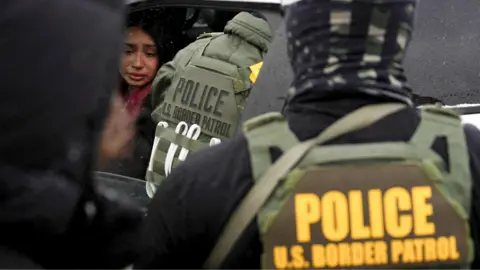 Reuters
The Department for Homeland Security says those who are in the US legally have nothing to fear
Those detained in the ICE raids have included some joint US-Somali citizens, though their relatives were too afraid to talk to me. Other families split up by deportations to Somalia were also fearful of going on the record - often too traumatised.
If deported, a person faces a 10-year bar on returning to the US, sometimes longer, even if they have any children in the country.
The US Department for Homeland Security (DHS) says its Operation Metro Surge in Minnesota has been a victory for public safety.
"We have arrested over 11,000 criminal illegal aliens who were killing Americans, hurting children and reigning terror in Minneapolis because sanctuary politicians refuse to protect their own people and instead protect criminals," it told the BBC in a statement.
In Adbi's mind the situation remains an existential crisis: "I would rather live in hiding here for the rest of my life than go back to Somalia, because my life would be at risk."
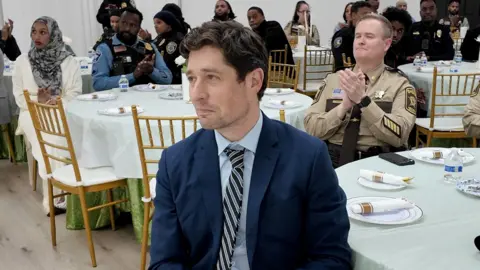 BBC / Brian Khisa
Minneapolis Mayor Jacob Frey questions how TPS can be removed for Somalis on the one hand, while warning people not to travel to Somalia on the other
For Minneapolis Mayor Jacob Frey, such fears point to a contradiction at the heart of US policy.
"The federal government is saying there's no need for Temporary Protected Status in the United States, while at the same time warning people not to travel to Somalia because it's dangerous," he told the BBC.
Walking through parts of Minneapolis, home to several migrant communities, the impact of the raids is still visible - even if daily life is slowly beginning to return to some normality and schools have reopened.
A few shops and restaurants remain closed, their doors shut during what would normally be a busy time.
In a car park outside a Chinese takeaway, I met a tow-truck driver removing cars.
"I heard the owner and the staff of this restaurant were detained by ICE, and that's why it's been shut down," he said, adding that some vehicles had been sitting there for days because their owners were too afraid to return.
"We are living through some dark times," Minnesota congresswoman Ilhan Omar recently told a Democratic convention in Minneapolis.
Afterwards, the first Somali-American to serve in the US Congress told the BBC how difficult the last few months had been - even for children.
"There is still that fear that you will get stopped, that your parents might get stopped. Even our healthcare centres have been impacted."
A fierce critic of Trump, who has repeatedly been targeted in the president's remarks about Somali immigrants, she questioned the scale of the operation and the tactics used by ICE.
"The difference between what we've previously seen with other administrations, including the [Barack] Obama administration that had one of the highest rates of removal, is that that process… was done without creating chaos [and] fear.
"The way Operation Metro Surge was carried out was having men in our streets who are masked, who are not identifiable, in great numbers with military grade weapons drawn at people. What we saw here looked like a war zone."
The DHS maintains those in the US legally have nothing to fear and that ICE agents wore masks to "protect themselves from being doxed by terrorist sympathisers".
Doxxing is when personal information is maliciously posted online and, according to the DHS, assaults against ICE officers have surged.
The tensions have also been heightened by Trump's comments about Somalis, calling them "garbage".
"I don't want them in our country, I'll be honest with you… their country is no good for a reason," Trump told reporters.
The US president has repeatedly highlighted a long-running scandal allegedly involving members of the Somali community in Minnesota, as well as others.
Governor Tim Walz announced he was dropping his re-election bid after criticism about the way he has handled the issue.
The investigation into the alleged fraud ramped up last week with raids on more than a dozen childcare day centres.
But Omar said immigration enforcement should not be tied to separate criminal cases.
"The majority of the people indicted are US citizens," she added.
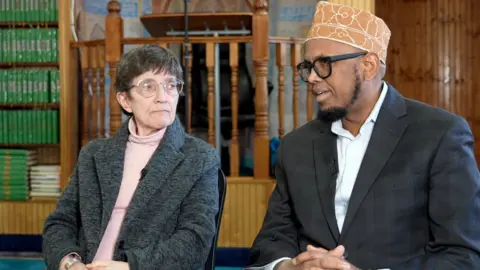 BBC / Brian Khisa
Faith leaders in Minneapolis have been brought together by the ICE raids
Jim Abeler, a Republican member of Minnesota's Senate, is also critical of ICE's tactics - but he feels it points to deeper policy failures that need fixing.
"I don't think this is a party issue. Our national immigration policy is a mess - it's been a bipartisan failure for a decade," he told the BBC.
Trump's comments about Somalis have dented Republican support among the community in Minnesota, where he had some fans in the socially conservative society ahead of his second term.
"I voted for Trump - and regret doing that," Foos Abe from Minneapolis told me. "If I hadn't voted for him, he couldn't have called us 'garbage'," she said.
One thing Operation Metro Surge has done is bring people together in unexpected ways.
This includes Somali-American Imam Sharif Muhammad and Jane Buckley Farley, a pastor at the Evangelical Lutheran Church in America.
I met them at a mosque in Minneapolis, where the imam described how the crisis had strengthened ties across faith groups: "The ICE raid created more closeness and more brotherhood and sisterhood."
The pastor agreed: "When the surge happened, people came together, asking where help was needed and how we could respond."
Together they set up informal alert systems to warn residents when immigration officers were nearby.
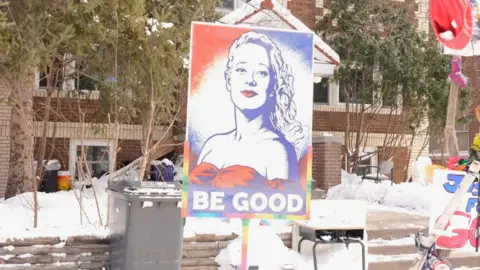 BBC / Brian Khisa
Volunteers like Renee Good, a US citizen shot by ICE and commemorated here in Minneapolis, warn people when agents are in the area
Two US citizens, Renee Good and Alex Pretti, who were members of similar volunteer groups, were killed by federal immigration agents during the surge in January.
Outside the mosque I met Lisa and her husband, a retired white couple who are both volunteer observers.
Asking me not to disclose her full name, Lisa explained how residents remained on alert and used whistles to warn others if immigration agents were seen nearby.
"It's quieter, but they're sneakier. They're blending in, so it's harder to tell," she said.
For Abdi, these volunteer networks offer some reassurance - though he admits he is despondent.
"We hoped for a future in America. Our dream has been shattered," he said.
Additional reporting by Brian Khisa, Tom Santorelli and Lucy Fleming
You may also be interested in:
 Getty Images/BBC





 English (US) ·