
 1 hour ago
7
1 hour ago
7
ARTICLE AD BOX
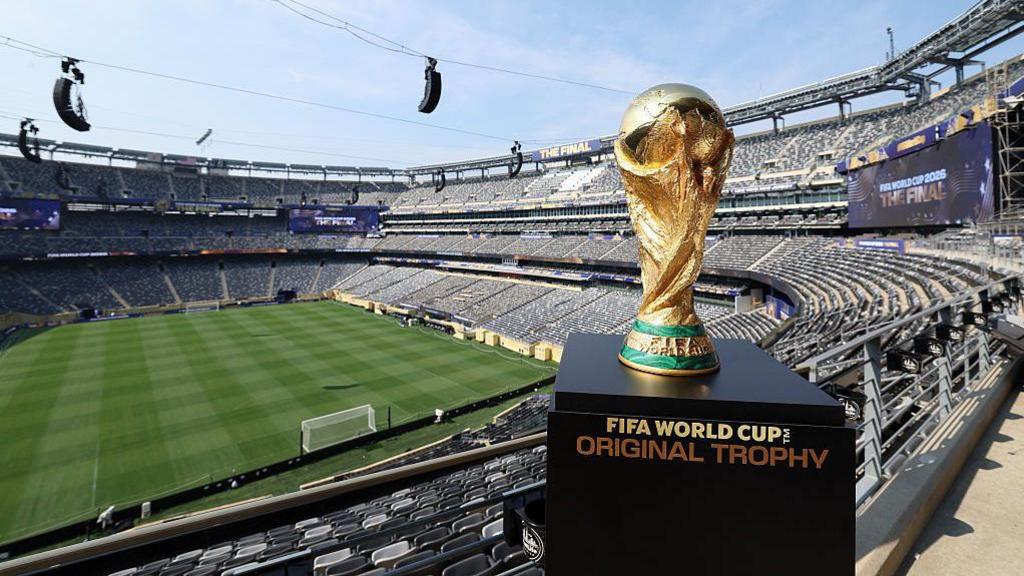 Image source, Getty Images
Argentina and Spain will contest the World Cup final at the New York/New Jersey Stadium on Sunday
By
Football issues correspondent
Fifa president Gianni Infantino promised the 2026 World Cup would be the "biggest event in the history of mankind".
Infantino likened the tournament in the United States, Mexico and Canada to 104 Super Bowls in one month.
It was a bold claim, so did it pan out like that?
For the first time, the World Cup featured 48 teams, with Curacao, Cape Verde, Jordan and Uzbekistan making their debuts. But did this dilute the quality of the tournament?
Then there is the mandatory, three-minute hydration breaks, regardless of conditions, which enabled broadcasters to cash in with commercials.
High ticket prices brought great controversy, but did they keep fans away?
The politicisation of the World Cup began before the tournament with visa issues and Iran's participation, then US President Donald Trump intervened to get Florian Balogun's red card overturned.
Pierlugi Collina, Fifa's head of referees, waged war on time-wasting and pushed through a raft of law changes. But did this make a real difference?
This is the story of the World Cup.
Was the World Cup expansion really worth it?
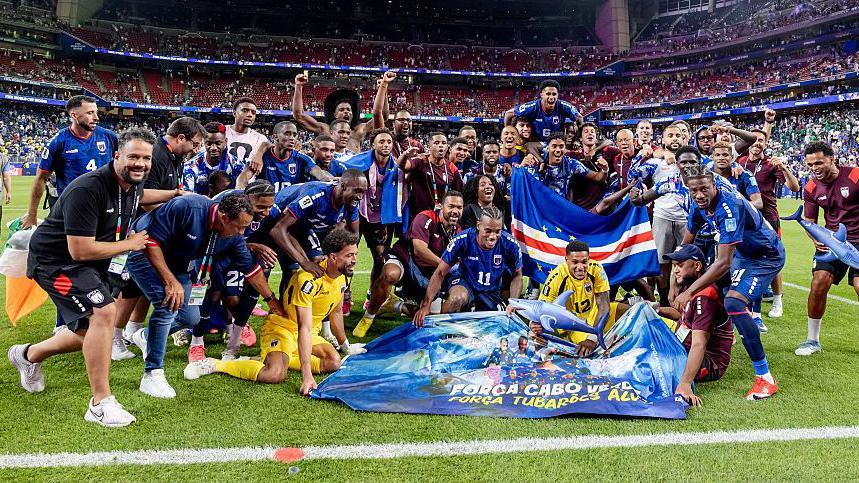 Image source, Getty Images
Cape Verde's qualification for the knockout rounds vindicated Gianni Infantino's decision to expand the tournament to 48 teams
If you wanted great storylines and colour, then the group stage was a success.
Watching debutants is always part of the allure of a World Cup, and Cape Verde brought it in spades.
A tiny archipelago in the Atlantic Ocean with just 530,000 people, Cape Verde claimed incredible draws against Spain and Uruguay (and Saudi Arabia too) to finish second.
Curacao shrugged off their 7-1 thrashing at the hands of Germany to claim a shock point against Ecuador, too. And DR Congo claimed a draw against Portugal and got out of their group.
Without these stories, the group stage would have been pretty dull, with the major nations making light work of it.
Seventy-two matches - more games than an entire World Cup used to have - to lose just 16 teams.
It was made worse by Fifa using head to head over goal difference as the first tie-breaker.
With eight third-placed teams going through, Australia-Paraguay and Austria-Algeria knew they could draw with each other and both teams would go through. And they did.
The drama only really began in the knockout rounds, with Cape Verde taking Argentina to extra time before losing 3-2.
It meant the African nation avoided defeat in 90 minutes against both World Cup finalists.
Without the expanded tournament, Cape Verde would not be at this World Cup, and the story of Vozinha, the 40-year-old keeper who inspired Cape Verde's historic debut, would not have been told.
How Fifa's new seeding policy influenced the final
New tournament, new seeding.
Fifa wanted to avoid the top-four ranked countries facing each other early in the knockout rounds.
So it gave Argentina, England, France and Spain special status to be drawn into separate quarters of the draw.
Without this rule, there was the potential they could have met as early as the last 16.
As it turned out, they landed into groups which kept them apart until the semi-finals anyway. It had no real influence on the top four ranked teams reaching the last four for the first time.
With one twist.
Fifa wanted to make it so the countries ranked one and two, Argentina and Spain, could not meet until the final. Just like in a tennis tournament draw.
To achieve this, Fifa had to swap Argentina into Group J, and put France into Group I.
What difference did this make?
Without the swap, England should have played France in the semi-finals, with Argentina taking on Spain.
An Argentina-Spain final would not have been possible.
Hydration breaks - the cash cow that will not go away
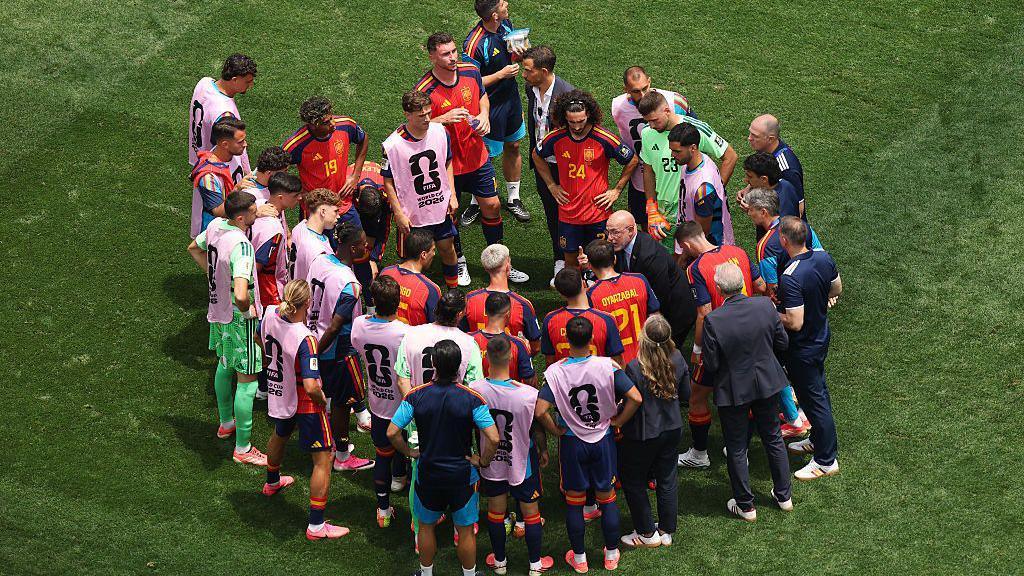 Image source, Getty Images
Hydration breaks enabled coaches to hold tactical team talks which changed the path of many games
Hydration breaks were, Fifa said, introduced to benefit player welfare, and sporting integrity meant they must be used equally in every single match.
Even in the air-conditioned stadiums of Atlanta, Dallas, Houston and Vancouver.
TV companies outside the UK switched to ads, which were allowed to begin 20 seconds after the referee blew the whistle and must have end 30 seconds before the action started again.
As the tournament went on, the boos from supporters got louder, such was the frustration at the stoppages.
Experts told BBC Sport that an average 30-second World Cup ad slot on Fox Sports in the US costs between $200,000 (£152,000) and $300,000 (£227,000), rising to $750,000 (£567,000) during USA matches and the final stages.
They were effectively tactical timeouts, with coaches getting devices out to run through tactical changes with the players. The course of several matches were altered.
Could we see them in other leagues?
Uefa has already ruled it out, and it is difficult to see them being accepted in the top European leagues.
But it would be no surprise to see them return for the next World Cup.
Have Collina's time-saving laws worked?
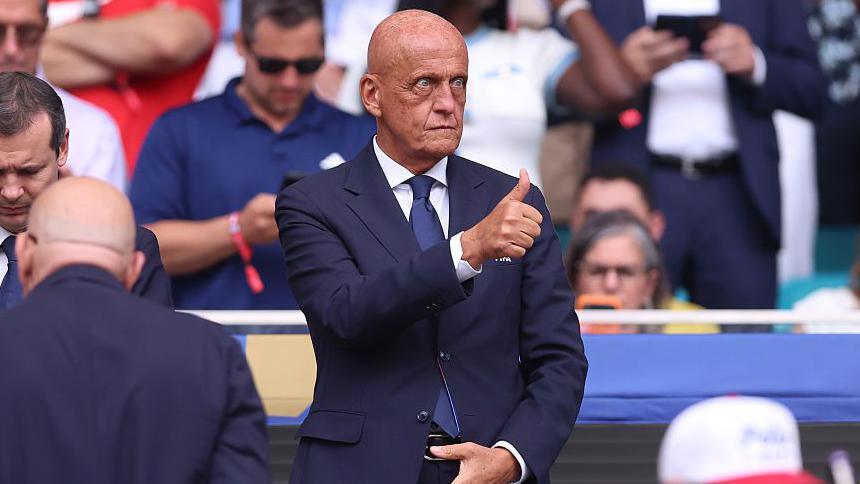 Image source, Getty Images
Pierluigi Collina brought in several measures to improve the tempo of games
Collina's priority for this World Cup was improving the tempo of games.
The Italian wanted his referees to make sure players were quicker on throw-ins, goal-kicks and substitutions. He also wanted to stop players going down with apparent injuries to cause delays.
So has it worked?
At the 2022 World Cup, Collina added time on for absolutely everything. That resulted in an average match length of 101 minutes 22 seconds for a ball-in-play time of 58 minutes three seconds.
At this World Cup, and removing the time lost to hydration breaks, it is 96 minutes 24 seconds for a ball-in-play time of 58 minutes 15 seconds.
Slightly more action, but much less time needed to achieve it.
In 2022, the game was played for 57.4% of the match length, this year it is 60.4%.
It has been a success in two ways.
The game flows better, it causes fewer frustrations for supporters over player conduct, and they get more football.
Let's see how this works out in domestic football next season, as the laws will apply there too.
Infantino's bold claim about attendances
With sky-high ticket prices, there was a feeling that many games at the World Cup might have swathes of empty seats.
This did not come to pass.
After the quarter-finals, Fifa announced stadiums had operated at near-full capacity at 99.7% with a record 6,527,410 fans attending matches.
So it seems people were prepared to pay Fifa's ticket prices.
Then Fifa brought in even more cash through its secondary resale platform, from which it added 30% in fees to every sale.
That does not mean there was no controversy.
Fifa was subpoenaed by the attorneys general of New York and New Jersey as part of an investigation into ticket pricing, practices and the accuracy of seat locations.
Supporters were initially banned from taking water bottles into grounds, until Fifa was forced into a U-turn.
Plus there was the high cost of transportation to get to the games in New Jersey and Boston - which also had to be slashed after a backlash.
Politicisation of the World Cup
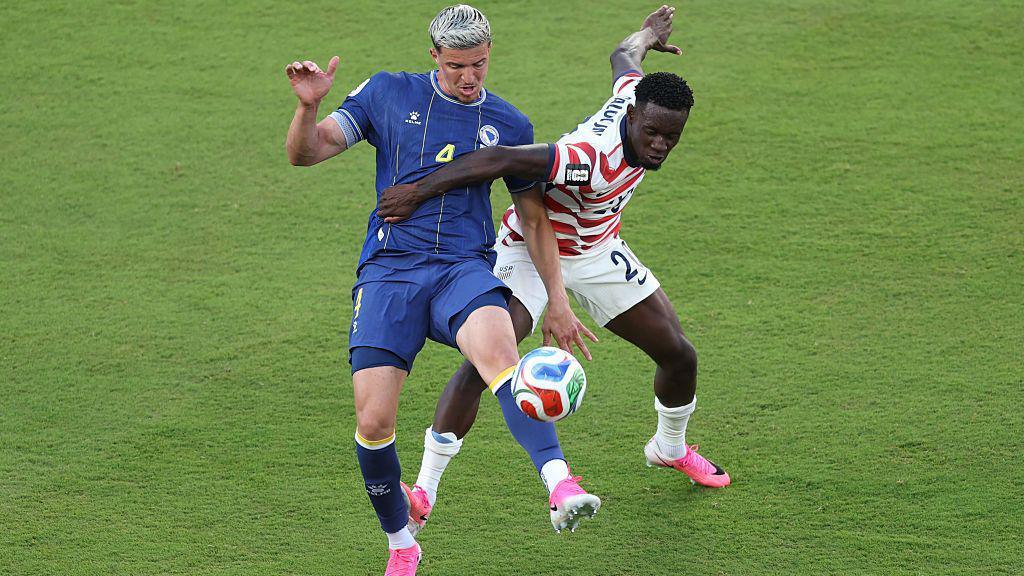 Image source, Getty Images
Folarin Balogun should have been suspended against Belgium following his red card against Bosnia-Herzegovina
The 2026 World Cup felt like it had been politicised from the start, with supporters of several nations unable to enter the country due to US immigration travel bans.
The story took an unexpected twist before the tournament even kicked off as Somali referee Omar Artan was refused entry at Miami Airport.
That led to an uncomfortable pre-tournament news conference for Infantino, in which he said people should just "chill, relax".
Iran faced obstacles throughout, with the US administration only allowing the team into the country for 24 hours around each of their three fixtures.
Markwayne Mullin, the United States' head of homeland security, said he "danced a happy dance" when Iran were eliminated.
Perhaps the biggest political controversy came when Trump called Infantino to try to get Balogun's suspension overturned.
One member of the Fifa disciplinary committee, Mohammad al-Kamali, then made a decision which had never been made before at a World Cup.
Rather than automatically miss the last-16 game with Belgium, Balogun's ban was suspended for 12 months.
Balogun played against Belgium, but a fired-up Belgium routed the co-hosts 4-1.
It raised serious questions about political interference in the tournament.
During the group stage, the video assistant referee (VAR) seemed to be running smoothly.
Then the knockout stages brought a lot of inconsistencies.
There has rarely been too much controversy with VAR at the World Cup in the past.
The Egyptian Football Association (EFA) called for an investigation following their 3-2 loss to Argentina, in which they had a goal ruled out on a VAR review.
Many other coaches complained about the standard of the refereeing, too.
The more games you have, the more video match officials you use, so the harder it is to get consistency.
There have been 37 VAR interventions so far at this World Cup, a frequency of 0.36 per game. That is about on par with the 0.37 in Qatar.
It is higher than the Premier League's 0.29.
On subjective interventions, when the referee goes to the monitor, this World Cup had a frequency of 0.27 per match - the Premier League is almost half this at 0.15.
So why does it feel better in the World Cup? Speed.
It is the biggest issue the game faces with video review in domestic football, but bar a couple of situations, the decisions were made very swiftly.
 English (US) ·