
 4 months ago
80
4 months ago
80
ARTICLE AD BOX
Rachel ClunBusiness reporter

 Getty Images
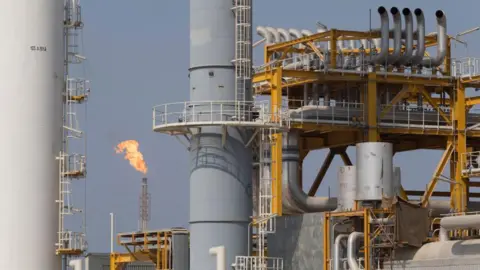
Facilities on the South Pars gas field pictured in 2016
Oil prices leapt to nearly $110 a barrel after Iranian media reported an airstrike hitting a facility on the world's largest natural gas field.
The Brent crude oil benchmark hit $109.91 a barrel just after 14:30 GMT, more than 5% higher than Tuesday's prices. It remains above $108.
The surge followed a report from Tasnim, a news agency affiliated with the Islamic Revolutionary Guard Corps, that Iran's petrochemical complex on the South Pars gas field had been hit.
The benchmark UK gas price also jumped by 6% to 143.53p a therm before falling back below the 140p mark.
While the price of both oil and gas spiked, they remained below highs seen earlier in the conflict.
Oil reached $116.78 a barrel on 9 March, while UK gas reached 162.55p a therm on 3 March.
Iran's oil ministry said a fire at the petrochemical complex was under control on Wednesday afternoon, Tasnim reported, but the extent of the damage to the facility remained unclear.
Iran's military warned it would take "decisive action" in response to the strike on its energy infrastructure.
"As previously warned, if the fuel, energy, gas, and economic infrastructures of our country are attacked by the American-Zionist enemy, in addition to a powerful counterattack against the enemy, we will severely strike the origin of that aggression as well," the military said in a statement published by Tasnim.
"We consider targeting the fuel, energy, and gas infrastructures of the countries of origin legitimate and will retaliate strongly at the earliest opportunity."
Qatar also operates facilities on the gas field, which it calls North Dome.
But the country, which produces a fifth of the world's liquefied natural gas, had halted production earlier in March in response to the conflict.
Qatar's foreign ministry spokesman Majed Al Ansari said strikes against energy infrastructure "constitutes a threat to global energy security".
'Energy markets will likely remain volatile'
AJ Bell's head of financial analysis Danni Hewson said the attack and retaliation by Iran had "helped dial up the temperature once again and put renewed upward pressure on oil prices".
"Any solution to the blockage of the Strait of Hormuz looks pretty distant at this point and unless and, until there is progress on that front, energy markets will likely remain volatile," she added.
The White House on Wednesday responded to the rising oil price by saying it was suspending the Jones Act — a 1920 law that says only American-made ships can be used to transport goods between US ports.
US Press Secretary Karoline Leavitt said the 60-day waiver of the rules, which are intended to boost shipbuilding, will allow "vital resources like oil, natural gas, fertiliser, and coal to flow freely" as non-American-made ships can now be used.
However, maritime groups in the US said the effect would be minimal, noting that oil prices, not shipping costs, are behind rising prices at the pump.
Meeanwhile, Iran has also suspended the flow of gas to Iraq in response to the attack to shore up domestic supplies, a senior Iraqi official told Reuters.
The vast majority of Iran's gas supply - 94% - is used domestically, according to data from the Gas Exporting Countries Forum.







 English (US) ·