
 1 month ago
64
1 month ago
64
ARTICLE AD BOX
33 minutes ago
Ione WellsSouth America correspondent, Lima, Peru

 EPA/Reuters
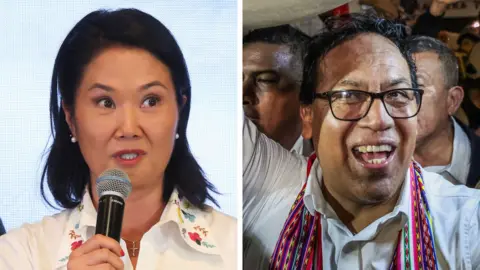
Peru's presidential election is stuck in a statistical tie, according to an early tally by the pollster Ipsos, echoing previous elections that have dragged on for days or even weeks.
It put the left-wing Roberto Sánchez on a marginal lead of 50.3% of the vote, compared with the right-wing Keiko Fujimori on 49.7%. While not an official count, the tally has been an accurate indicator of the final result in previous polls.
Official results confirm the race is extremely tight with more than 85% of votes counted.
The election pits Fujimori, a mainstay of Peruvian politics, against Sánchez, who is promising broad economic reforms. Concerns over crime and political instability have dominated the race.
Recounts will likely be needed to confirm the winner, a process that could take weeks.
Ipsos showed Fujimori dominating the capital Lima, carrying the urban vote and the coast, while Sánchez swept the rural vote and the mountainous Andes regions. Sánchez is expected to gain ground as ballots from rural areas are tallied.
Sánchez told supporters the early count was an "important lead that reaffirms the will of the people, who want democracy and justice."
Fujimori, on the other hand, said the result showed a "dead heat" and that there will be long "days ahead" to declare a winner.
She said it would be "irresponsible" to determine the result on early samples and that "every single tally sheet must be counted".
 EPA
EPA
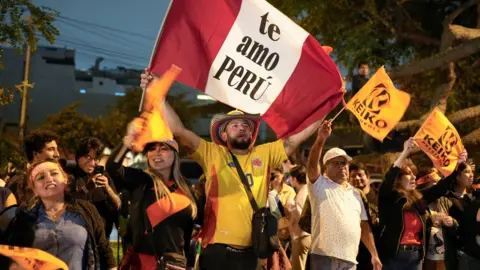
Keiko Fujimori's supporters seen on the streets of Lima on Sunday night. The right-wing candidate is one of the most well-known figures in Peruvian politics
Sánchez also reiterated that he would seek a "presidential pardon" that would free the former left-wing president Pedro Castillo.
In 2021, Castillo also ran against Fujimori and finished with a similarly close result, which led to the declaration dragging on for weeks. Castillo was eventually jailed after trying to illegally disband Congress and govern by decree, and Sánchez served as a minister in his government.
Fujimori is one of the most well-known figures in Peruvian politics, and this is her fourth time running for office.
Her late father, Alberto Fujimori, was formerly the president of Peru and was eventually jailed for crimes against humanity. But his supporters credited him with a tough crackdown on violent insurgencies and implementation of social programmes to help some of the country's poorest.
His controversial legacy is one she leant into throughout the campaign, promising a tough military crackdown on organised crime, in particular extortion incidents that have soared in recent years.
Fujimori began her election day having breakfast in the Lima suburb of San Juan de Lurigancho, the most populous district in Peru, where impoverished neighbourhoods crowd the steep, dusty mountains. She was welcomed by crowds of supporters gathering for selfies with her.
"She will fight crime like her father did years ago," one supporter, Alicia, said.
"It's about time a woman governed us, one who makes us feel valued," another, Catalina Solana Guamá, added.
"Previous presidents didn't remember towns like ours, our hillside where we live, the needs people have. Her father travelled around, walking through the mud and sludge here, I want her to go out, not to be an office-bound president, and to be for the people and fight like that," she said.
Catalina welcomed Fujimori's pledge to use the military to tackle crime, saying she wanted her to "fight against those criminals who are killing drivers and bus conductors".
"It's not right that we go out to work and don't know if we'll come back alive."
 Getty Images
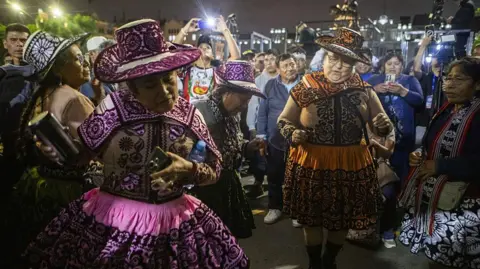
Supporters of Roberto Sanchez gathered in Lima on Sunday night. He has promised sweeping left-wing reforms to the state and economy
Another, Jennifer, said "right now things are very bad, especially in this district of San Juan de Lurigancho, there's extortions and killings, she wants to fight that".
Roberto Sánchez fought his campaign promising sweeping left-wing reforms to the state and economy including a greater role for the state in Peru's natural resources, investing more heavily in rural areas, reforming the tax system, and reviewing mining contracts.
He argues this is necessary to tackle inequality and redistribute wealth from Peru's rich mineral, gold and copper reserves more equally and has enjoyed subsequent support in more rural areas. But his policies have rattled financial markets.
His supporters fiercely criticised Fujimori and her father's legacy. One, Giovanna, who stood in a crowd waiting to watch Sánchez speak following the results, said Fujimori's family had "done a lot of damage to our country", referencing Alberto Fujimori's forced sterilisation programme.
Some supporters said that if he did not win, they would protest.
"Our voices must be raised, if we have to rise up, at the very least I would do it," Giovanna said.
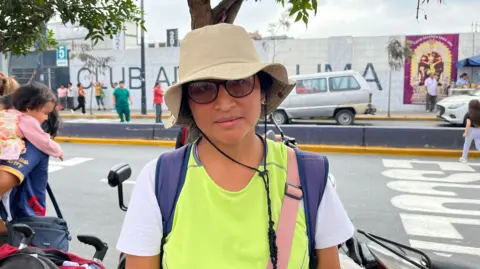
Street vendor Hilda vowed to protest, saying: "We voted for change"
Everyone is going to protest, we are going to go out into the streets, we voted for change," a street vendor, Hilda, said.
"Previously we voted for Pedro Castillo, but our president who was elected has been removed and is in prison. That's why we're voting for Sánchez."
A chaotic first round led to accusations of fraud and threats from both sides, after some polling stations faced delays receiving electoral materials.
Election observers and Peru's ONPE electoral authority said that voting in the second round had taken place without major issues.




 English (US) ·