
 3 months ago
69
3 months ago
69
ARTICLE AD BOX
Mark SavageMusic correspondent

 Getty Images
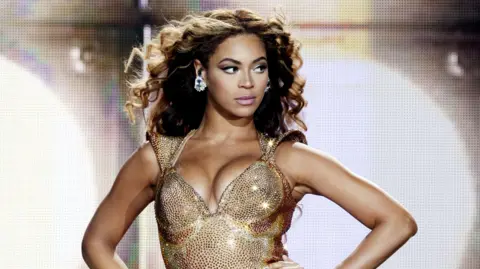
Beyoncé is among the artists whose voice has been cloned by people trying to skim money from streaming services
Music giant Sony Music says it has requested the removal of more than 135,000 songs by fraudsters impersonating its artists on streaming services.
The so-called deepfakes were created using generative AI, and targeted some of the company's biggest acts, who include Beyoncé, Queen and Harry Styles
The proliferation of such counterfeits causes "direct commercial harm to legitimate recording artists", Sony said - and deliberately target musicians who are promoting a new album
"In the worst cases, [the deepfakes] potentially damage a release campaign or tarnish the reputation of an artist," said Dennis Kooker, president of Sony's global digital business.
The company says the number of songs generated in this fashion is only increasing as artificial intelligence technology becomes cheaper and easier to access.
It believes the 135,000 tracks it has discovered to date represents just a percentage of the total uploaded to streaming services.
Since last March alone, it has identified some 60,000 songs falsely purporting to feature artists from their roster. Other acts who may have been affected include Bad Bunny, Miley Cyrus and Mark Ronson.
"The problem with deepfakes are they are a demand-driven event," said Kooker. "They are taking advantage of the fact an artist is out there promoting their music.
"That is when deepfakes are at their worst - building off and benefiting from the demand the artist has created [and] ultimately detracting from what the artist is trying to accomplish."
The revelation came at the launch of the music industry's Global Music Report in London on Wednesday.
Figures released by the International Federation of the Phonographic Industry (IFPI) showed that recorded music revenues grew by 6.4% last year, reaching $31.7 billion (£23.8 billion).
It was the 11th consecutive year of growth, after streaming subscriptions rescued the industry from a period of piracy and financial decline.
The UK remained the world's third largest music market, while China overtook Germany as the fourth biggest, having entered the top 10 less than a decade ago.
 Reuters
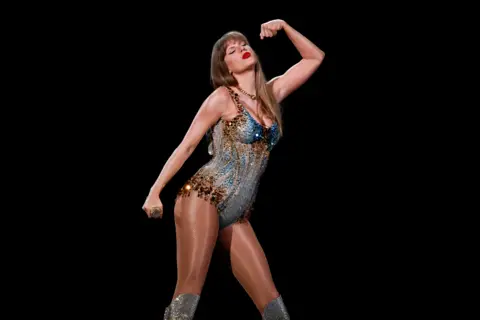
Taylor Swift was the biggest artist in the world last year, followed by K-pop band Stray Kids and Canadian rapper Drake
Attendees scrambled to digest the findings before the presentation began - and there was a sense of relief that the government had ditched plans to allow AI firms to train their software on copyrighted works without permission.
"I think we've seen a lot of governments really grappling with this issue because they are trying to square a circle: They are trying to protect creativity and at the same time encourage innovation," said Victoria Oakley, CEO of the IFPI.
"I'm very optimistic that... in the UK, they [have] decided to pause and think again."
AI music 'should be labelled'
While unregulated AI has been a major concern for musicians, the music industry also raised concerns about streaming fraud.
Also known as streaming manipulation, the practice involves "fake" artists uploading song to sites like Spotify, YouTube, Instagram and Apple Music, and artificially boosting their play counts, in order to gain royalty payments.
The IFPI says the advent of AI has "supercharged" the practice, which ultimately robs legitimate artists of payments.
Unofficially, the music industry believes up to 10% of content across all streaming platforms is fraudulent.
"I hate to say it, but it's very simple to fix," said Oakley, calling on streaming services to implement tools that can identify fake or AI-generated music when it is uploaded.
"The challenge of identifying and labelling AI material is absolutely the next critical challenge," she added.
Kooker pointed out that the French streaming company Deezer already had software capable of this task - and claims that 34% of the songs submitted to its service are now categorised as AI-generated.
"Is it perfect? I'm sure it's not, but it's open and it's transparent, and it allows people to understand what is happening," said Kooker.
"Without proper identification, fans can't distinguish between genuine human creativity versus unauthorised, AI‑generated content, which risks creating confusion, undermining trust, and impacting user experiences.
"Transparency shouldn't be optional, it's the foundation of a fair and sustainable music ecosystem."




 English (US) ·