
 1 month ago
84
1 month ago
84
ARTICLE AD BOX
10 minutes ago
Faisal IslamEconomics editor

 BBC
BBC
It's 9am at Kew Bridge in west London, and tourists, runners and dog walkers are queuing up at the Dear Coco vintage Italian coffee cart.
It is high-grade coffee made from the arabica bean, brewed in an expensive La Marzocco machine - and the price shows that, at £4.50 for an iced latte, £4.10 for a 10 oz latte, and £3.90 for a 6 oz flat white.
It's a price tag that would have once looked strikingly high, but across much of the UK the £4 threshold is well broken, including in chains that do not use the highest-grade beans. A large coffee in central London, served with an alternative milk like soy or almond, is now closer to the £5 mark.
Earlier this month in the US, Starbucks CEO Brian Niccol came under fire for suggesting a "$9 [£6.68] experience" at one of his outlets was a "really affordable premium experience".
The man working at the cart in Kew doesn't agree. He is relatively lucky; carts pay street trading fees rather than soaring rents and business rates. But still, he is squeezed. "We feel super strongly about keeping the price of a flat white under £4 for as long as possible," Anthony Duckworth tells me, as rowing boats glide past. "But it's becoming increasingly difficult, because every part of the supply chain has become more expensive. We think there's a really important psychological threshold around that four pound mark."
Coffee is not just a morning ritual, repeated worldwide: in fact, it's an insight into the modern global economy. The latte sheds light on everything from commodity inflation to trade chaos; from geopolitical strife and climate change to Gen Z cultural tastes. It teaches us about rampant new demand from the Chinese middle class, and the long-hanging economic effects of the Vietnam War.
It's all there, in every frothy cuppa.
The modern coffee journey started in Turin, northern Italy, at a train station in 1895. Steam-powered coffee machines were developed to cater to time-poor travellers, often on the Milan express - one theory for the name "espresso". It was the start of mass consumption of what had originally been a luxury drink.
Near the Turin ring road, at a glass and steel structure, I speak to Giuseppe Lavazza, whose great-grandfather launched the Lavazza coffee brand 131 years ago. "The secret of surviving is having a company ready to modify," he tells me while holding what he hopes is his next great innovation: a cookie of coffee, called a tabli, that he hopes will serve the growing at-home coffee market, without the need for environmentally questionable metal pods.
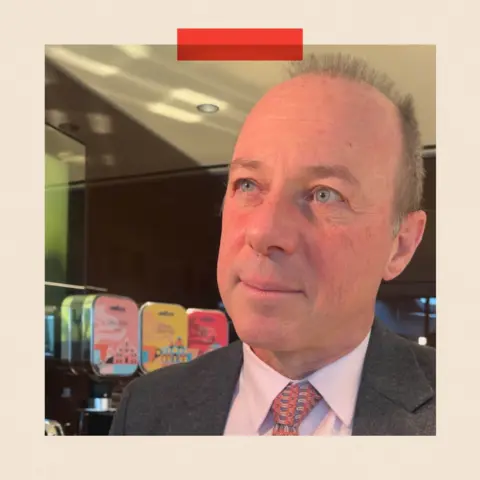
Giuseppe Lavazza says that despite high prices, demand for coffee has stayed resilient
In recent years his industry has encountered serious hiccups - affecting both of the world's most important coffee beans.
At one end of the market, arabica beans, known for their sweetness and aroma, are hand-picked at cool altitudes in Brazil, Ethiopia, and Kenya; it's a careful process, even more intricate than the harvesting of grapes for the finest champagne. At the other end, robusta beans, known for their high levels of caffeine, are mass harvested by machines. Vietnam has cornered the market on robusta since emerging from its war in the 1970s.
Two years ago, a convergence of climatic events pushed the price of both beans to multi-decade highs.
In early 2024, Vietnam suffered its worst drought in decades (rainfall collapsed by 30%); then, late last year, a typhoon during harvest hit production too. And in Brazil, farmers are still struggling to recover from a severe frost in 2021 that damaged the arabica crop.
As a result, arabica prices peaked last year above $4 (£2.97) per pound of green beans, up from about $1.20 historically. It has now settled at $3.08. Robusta beans increased even more, reaching $2.59 (£1.92) before settling at about $1.56. Both beans now cost significantly more than they did before 2020.
Lavazza calls the last few years an "unprecedented time in terms of complexity and troubles". And he says prices are unlikely to drop any time soon. "Unfortunately, we have to wait for at least a couple of years, because we need two big crops from Brazil, Vietnam, arriving on the market that could create a different market condition."
Lavazza also points to speculation in the financial markets.
Every morning at 4.30am, thousands of Vietnamese coffee farmers check their smartphones to see the prices (and predicted future prices) of robusta beans. It's become a daily ritual. And the Hanoi office of the US government's Foreign Agricultural Service says that with price information so easily available online, many farmers are choosing to store - rather than sell - their coffee beans after harvest, in the hope prices will rise further. Essentially, they're playing the markets.
All eyes are now on July's crop in Brazil. Some analysts expect a bumper harvest of the arabica bean, which should drive down prices. On the other hand, the prospect of a "super" El Niño predicted this autumn - a warming of the Pacific Ocean that occurs every few years - could lead to more turmoil.
And of course, there's another, more familiar source of disruption in coffee markets.
A curiosity of Donald Trump's 'Liberation Day' tariffs, announced last year, was that coffee producing nations were sharply hit. Vietnam faced a 46% tariff, Indonesia 32%, and Brazil 50% (after an escalation from 10%). The coffee belt also happened to be the tariff belt.
It caused chaos on world coffee markets. Brazilian exports to the US fell off a cliff, more than halving last summer. And the prices of beans from lower-tariffed countries (like Colombia) also went up, because American suppliers raced to import them.
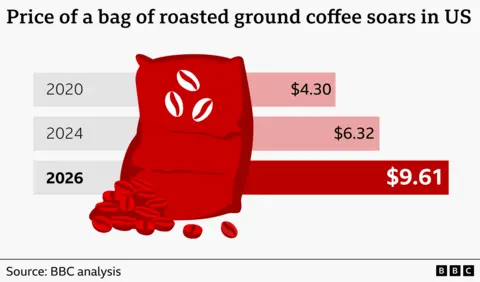
And American coffee-drinkers have noticed. US roasted coffee prices surged by 17% in the year to March, whilst instant coffee rose a near-record 25% - faster than gasoline prices (in fact, they were the single fastest-rising item in the entire inflation basket, apart from fuel oil). A bag of ground roast coffee that cost $4.30 in 2020 was already $6.32 in 2024, and is now $9.61 and heading for $10. The cheapest forms of coffee have been hit hardest, hurting poorer Americans.
 Getty Images
Donald Trump imposed tariffs against some coffee-producing countries last year - but later signed an executive order giving coffee beans a free pass
Brazil's exports were diverted to Europe, with Germany overtaking the US as the biggest importer of Brazilian beans over the course of 2025, cushioning Europe's coffee drinkers to a degree.
With angry American voters facing higher prices in supermarkets, in November last year Trump signed an executive order allowing coffee beans (along with other foods like bananas and beef) to escape his sweeping tariffs.
To many, coffee seemed to expose a flaw in the White House's tariff policy. Trump said he imposed tariffs against countries that were "cheating America" - but arguably Vietnam's dominance over coffee production is simply a result of what economists call its "comparative advantage" (mostly its climate and low labour costs), rather than the result of cheating.
Trump also said tariffs would help to reshore industry - but that's largely irrelevant in the case of coffee, which requires a subtropical climate.
It took an import collapse and a price spike for a rather predictable lesson to land.
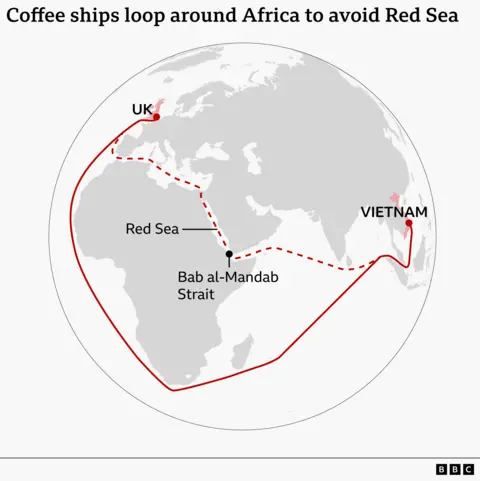
The chaos in global shipping is also playing its part. Ships transporting those Vietnamese beans to Europe now have to loop around the southern tip of Africa, to avoid the threat of Houthi militants at the Bab al-Mandab Strait, at the southern end of the Red Sea, between Yemen and the Horn of Africa. That journey is about 4,000 miles longer than it was before 2024.
And new EU anti-deforestation rules, due to come into effect across 2026 and 2027, are having an effect too. In order to ship coffee to Europe, Vietnamese and Brazilian suppliers will soon have to supply the GPS coordinates of their plantations. EU officials will then use satellite images to check the beans are not coming from land that was a forest in the past five years. The policy has repeatedly been delayed, but the cost for farmers is already adding up.
But here's the really interesting thing about the current coffee shock. So far, consumers are still paying up. Demand is what economists call inelastic, meaning it doesn't respond to price signals.
"We saw that despite the high prices, people love having coffee," says Lavazza, in Turin. "We don't see any significant decrease in terms of volumes in the most important countries."
In an age of higher prices, he says, it's important to recognise there are "different ways of approaching coffee" - like boosting production of the increasingly fashionable cold brews.
In general, the growing popularity of cold brews among young people could be seen as an example of so-called 'premiumisation', where businesses make their products look fancier to justify higher prices.
 Getty Images
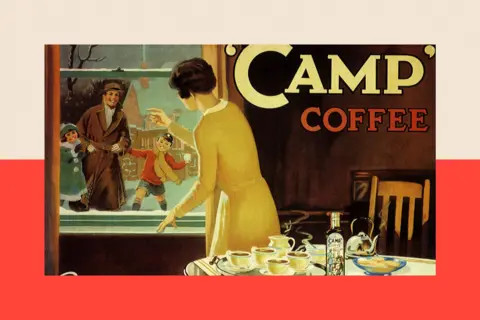
Coffee marketing has evolved since steam-powered machines first emerged to serve travellers on Italy's railways in the late 19th Century
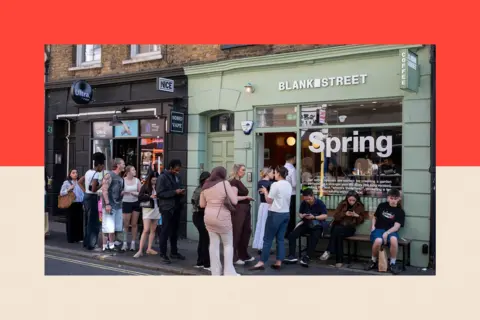
Another example is the chain that used to be known as Blank Street Coffee, founded in New York and developed by former venture capitalists. The baristas, who sell elaborate fruit and cake-themed concoctions, are supposed to connect with customers as "brand ambassadors". It uses this curated experience to justify higher prices.
And some coffee shops have become so fancy that they have lost the coffee entirely. Instead, 'matcha' has been on the march among younger customers. The drink's bright emerald colour has attracted the TikTok generation, and the milder caffeine hit from its green tea powder is suited to health-conscious drinkers who want good sleep. Blank Street rebranded last year, losing the word 'coffee' from its title and adopting a green hue.
And China shows a version of where this all may be heading. Luckin Coffee, founded in Beijing, is chasing Starbucks for the title of world's biggest coffee chain. Luckin developed as a tech company with astonishingly detailed data about how customers' preferences change by day, and by different weather.
 In Pictures/Getty Images
Coffee chains like Blank Street have embraced "premiumisation", selling experience as much as coffee
They also know exactly when their customers' phones are within range of a kiosk. Their coffee is served up personalised, allowing customers to pick sugar levels and coffee-to-milk ratios, with different recommendations triggered by sun or rain. Their cafes are not designed for seating, but for the rapid delivery of caffeine, ordered by apps. Luckin is expanding into the US.
And on the other end of the market, the British chain Greggs has managed to keep prices low via automation. The bakery uses bean-to-cup Swiss machines to make some of its coffee. A regular latte is about £2.40, much lower than in other UK coffee cafes. It is now Britain's largest coffee provider, with more outlets than Costa.
In essence, it's a story of two halves.
On the one hand, there's a supply chain tsunami - involving climate problems and geopolitical tensions - pushing up prices.
But on the other hand, there's a coffee-loving public who are happy to pay the extra costs.
The commodity price surge matters significantly in supermarkets, but less so in cafes, which are now in the business of selling experiences, rather than drinks.
And prices will stay sticky, even if the harvests in Brazil and in Vietnam normalise and the price of raw coffee retreats a little.
That £5 large latte could be here to stay.
Top image credit: Getty Images

BBC InDepth is the home on the website and app for the best analysis, with fresh perspectives that challenge assumptions and deep reporting on the biggest issues of the day. Emma Barnett and John Simpson bring their pick of the most thought-provoking deep reads and analysis, every Saturday. Sign up for the newsletter here


 English (US) ·