
 1 month ago
54
1 month ago
54
ARTICLE AD BOX
19 minutes ago
Suranjana TewariAsia Business Correspondent, Beijing and Hefei, China
Global carmakers are facing a reckoning as US, European and Japanese brands lose ground to Chinese rivals setting the pace not only in electric vehicles, but also in batteries, design and software.
The BBC visited factory floors in Beijing and Hefei on the sidelines of Auto China 2026 - the world's largest car show - and found striking levels of automation and software development speed, leaving foreign brands that once dominated the Chinese market struggling to keep up.
"We have no chance against this," Honda chief executive Toshihiro Mibe told Japanese media after visiting a highly automated factory in Shanghai.
Ford chief executive Jim Farley has also warned that Western carmakers, are "in a fight for our lives" as Chinese rivals expand globally.
After decades spent investing in joint ventures with Chinese partners to build vehicles, foreign carmakers are now changing the nature of those partnerships to stay competitive.
"The biggest mistake that the developed world is making is believing that the transition is only about electric cars," says Shanghai-based auto analyst Bill Russo. "It's about who will lead the next generation of mobility technology."
China's dominance goes beyond the cars themselves.
It makes the most exports in more than 315 product categories, up from 163 in 2016, according to a report by Rhodium Group. Many of these are linked to electric vehicle (EV) supply chains, including batteries, components and manufacturing machinery.
The International Energy Agency estimates it is at least 30% cheaper to produce a small electric SUV in China than in more advanced economies, largely because of lower battery costs and elaborate supply chains.
That advantage was built through years of state support. Rhodium estimates China has channelled tens of billions of dollars into EV and battery manufacturing in recent years alone.
Those subsidies, heavily criticised in the EU and US for distorting markets, have helped companies expand rapidly and cut prices.

 Getty Images
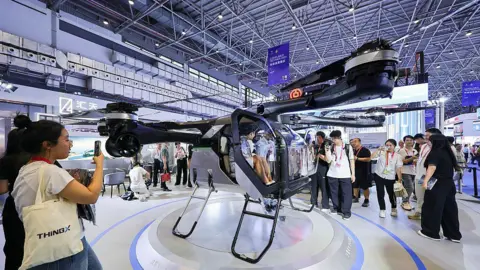
Xpeng told the BBC it is now prioritising the development of robots and flying cars
Competition inside China has also sped up innovation. Tech giants like Xiaomi, Huawei and Alibaba are now making EVs, bringing consumer technology into the car industry.
"They're not racing the West anymore," says Russo. "They're racing each other."
As cars increasingly rely on software, from driver assistance to entertainment systems, these companies are giving Chinese carmakers yet another edge.
The shift is most visible inside Xiaomi's EV factory outside Beijing, where a car rolls off the production line roughly every 76 seconds.
Xiaomi only launched its first EV in 2024 but it is already one of China's top-selling brands. Its strategy is to connect cars with phones, apps and smart-home devices to create a single system.
At Nio's Hefei plant, parts of the production line are almost fully automated.
BYD has developed ultra-fast charging systems capable of adding 400km (249 miles) of range in around five minutes, close to the time it takes to refuel a car with petrol.
XPeng's founder and CEO He Xiaopeng told the BBC the company is prioritising humanoid robots and flying cars alongside EVs.
"In the next decade, any car company will also be a robotics company," he said.
Foreign carmakers already rely on China to supply global markets. Tesla exports Shanghai-built Model 3s to Europe, while BMW's Chinese-made electric Minis are also sold overseas.
But many have struggled inside China itself.
Foreign brands' share of China's car market has fallen from 64% in 2020 to 32% this year, according to consultancy Automobility.
The decline has hit earnings at General Motors (GM) and German manufacturers, which once relied heavily on China for profits.
Luxury brands are also under pressure. Huawei's Maextro S800 luxury sedan has become China's best-selling car above $100,000 (£74,145), outselling imports like Porsche Panamera and the BMW 7-series combined, which once dominated the Chinese market.
 Getty Images
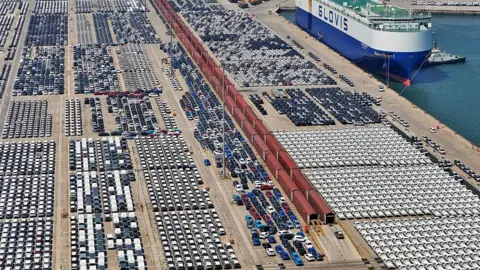
China exports about seven million cars a year, nearly half of which are EVs
For decades, foreign carmakers brought technology and branding while local partners provided factories and a market.
Now that relationship is changing.
Stellantis has just signed a €1bn ($1.16bn; £863m) deal with state-backed Dongfeng to produce Peugeot and Jeep models in China to sell at home and abroad.
Stellantis will also bring Dongfeng's Voyah electric brand into Europe, and has said it is exploring producing Chinese-designed vehicles at a plant in France.
Volkswagen is paying $700m for access to XPeng's software architecture and autonomous driving systems to develop its next generation of EVs - technology it has acknowledged it could not develop fast enough at home.
XPeng's He says the relationship is two-way: "We study each other, so we trust each other, so we help each other."
Toyota, Hyundai, Ford and Nissan are also expanding research operations in China or exploring production of Chinese-designed vehicles in overseas factories - using local talent and knowledge for development rather than simply manufacturing.
Not every strategy is working though.
Audi has had to offer heavy discounts on its E5 model, which it had specifically made for China, after weaker-than-expected demand.
GM has written down billions of dollars from its China operations and reported a more than 21% decline in sales in the first three months of this year.
Japanese manufacturers have been slower to shift towards fully electric vehicles, leaving them vulnerable in China and, increasingly, in South East Asia, where Chinese brands are rapidly gaining market share.
In early 2026, Volkswagen briefly regained the position of the top-selling car brand in China, but that may have been because of the end of Beijing's EV subsidies, which, in turn, weakened domestic rivals.
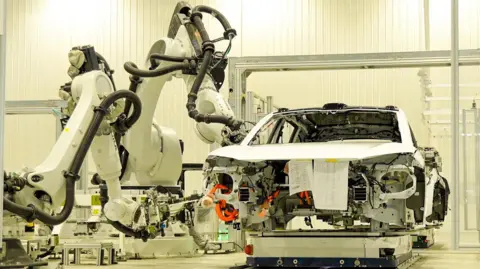
The BBC visited EV factories in China which were highly automated
China's domestic market is cooling more broadly too. Growth has slowed after years of expansion, while overcapacity and an intense price war are squeezing profits across the industry.
That is partly why Chinese manufacturers are expanding abroad. Brands such as BYD, Chery and SAIC are pushing into Europe and emerging markets despite tariffs of up to 45% in the EU.
Chery's Jaecoo 7 became one of the UK's best-selling new models within 14 months of its launch. But tariffs of more than 100% have effectively locked Chinese brands out of the US market.
Experts warn that as more vehicle production, battery technology and software development shifts towards China, manufacturing hubs in South East Asia and Europe could suffer, affecting jobs and local economies.
Tariffs will not necessarily protect them, says consultant James Pearson: "If you lock them out of one market, they will just find another."
Bill Russo says the industry's centre of gravity has already shifted.
The companies willing to collaborate have a chance, he says, while those trying to stop China's rise risk falling behind.






 English (US) ·