
 2 weeks ago
46
2 weeks ago
46
ARTICLE AD BOX

 Reuters
US agriculture and health officials have outlined a plan to combat a flesh-eating parasite that has been detected in the US for the first time since 1966.
The plan to prevent a US outbreak of the New World Screwworm focuses on deploying hundreds of millions of genetically-altered sterile flies. Experts, though, say the supply of sterile flies is too low to immediately impact and halt the growing screwworm population.
Other measures include establishing a containment zone around the site of the first US infection along the southern US border, and using sniffer dogs to detect the insects.
The threat to humans is low, but cattle ranchers fear an outbreak could have a large impact on beef markets.
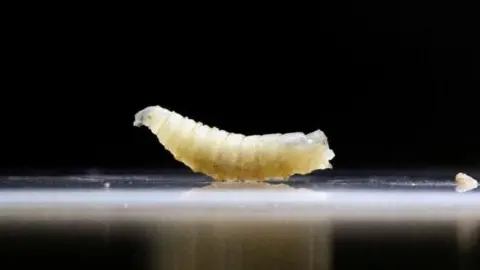
Screwworms are parasitic flies whose females lay eggs in open wounds and mucous membranes of living warm-blooded animals and people. When the eggs hatch, hundreds of larvae burrow through living flesh with sharp mouths, eventually killing their host if left untreated.
On Wednesday, US officials announced that the first case in 60 years was detected in a three-week-old calf, with the larvae found in its umbilical area. The discovery was made in the town of La Pryor, Texas, about 30 miles (48km) from the Mexico border.
Officials have set up a 20km-wide "control zone", and are "implementing quarantines, movement controls, and surveillance in this area," according to the US Department of Agriculture (USDA).
Screwworm larvae grow into flies which can travel short distances. The primary way that they have travelled long distances is by being brought by humans. There have been a handful of US cases since 1966, when travellers brought the pest back, but no larger outbreaks.
Officials in the US and in Latin America have been combating the problem of screwworms for much of the past six decades, with limited success.
 Getty Images
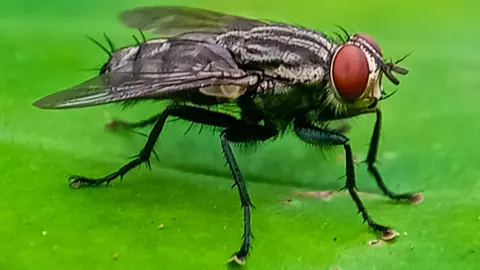
Screwworms grow after hatching from flesh, and can grow to be twice as large as the size of regular houseflies
One way to fight back is by releasing hundreds of millions of sterile screwworm flies, as the females only mate once in their lifetime, and any eggs they lay will be unfertilised and will not hatch.
This method, known as the Sterile Insect Technique, has been in use for many years to control a variety of insect populations, including fruit flies and mosquitos. It works by hatching flies in an enclosed space, and then exposing them to radiation to make them sterile before releasing them into the wild.
However, officials say that they will need to breed up to 600 million sterile screwworms flies each week in order to fight back the outbreak.
Currently, facilities in the US and Mexico are only capable of producing about 100 million sterile flies per week.
US Secretary of Agriculture Brooke Rollins told reporters on Thursday that since the discovery of the infected calf, officials have released four million sterile flies by ground, in addition to another four million that they have been releasing by plane on a weekly basis since February.
"There is no reason to believe that this incursion will result in any sort of establishment of the pests," said Rollins.
But critics, including cattle farmers in Texas, are worried it's not enough and some have accused the Trump administration of not taking the problem seriously.
The last outbreak that came close to threatening American cattle was in the 1970s, but at that time no screwworms were ever found inside the US.
The use of sterile flies pushed the screwworms south below the Darien Gap, Panama's heavily-forested border region with Colombia. At the time, officials were deploying around 500 to 700 million sterile flies across Central America per week, according to Sonja Swiger, an entomologist for Texas A&M University.
But in recent years, the screwworms have rampaged back north. In 2022, Panama reported a large increase in cases, followed by countries across Central America. By 2024, they had been reported in Mexico, and were creeping north towards the US.
This latest outbreak has so far resulted in 2,070 cases of screwworms in humans, according to the US Centers for Disease Control and Prevention (CDC).
CAN WE ESTABLISH WHAT HAPPENS TO HUMANS WITH THIS / WHETHER IT'S FATAL?
 Getty Images
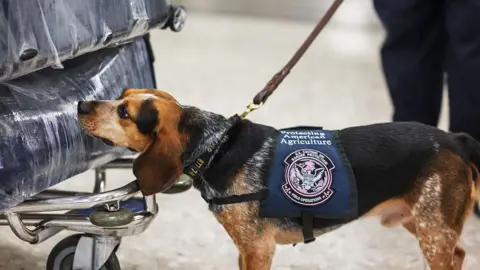
Specialised dogs that can sniff out screwworms, known as the "Beagle Brigade", have been stationed at US borders
Democrats have criticised the response so far as slow and delayed. They have pointed to Trump's decision to eliminate the US Agency for International Development (USAID), which maintained a programme to track screwworms in Central America.
Texas Agriculture Commissioner Sid Miller denounced the federal government for "a slow, bureaucratic, and incomplete response that allowed the pest to advance unchecked through Mexico and reach American soil".
Miller called for federal officials to use insecticide traps, a method which they dismissed in a news conference on Thursday, saying they were ineffective at stopping screwworms, and used chemicals believed to cause cancer to humans and wildlife.
Secretary Brooke, speaking to reporters on Thursday, blamed the screwworms' northward advance on "open border" policies, and cartel smugglers carrying livestock and pets.
She also criticised the government of Mexico, saying its response left "a lot to be desired".
As part of the response, the US is stationing dogs capable of sniffing out screwworms at the borders. These specialised dogs, which are employed by Customs and Border Protection and the USDA, are known as the "Beagle Brigade".
Officials say that to combat the spread, ranchers must be diligent about covering wounds on their livestock, to prevent screwworms from taking hold.
People should also check themselves and their pets, and immediately report any detections to officials.
The screwworms are typically found in warmer climates, but may now be moving further north due to climate change. They are native to tropical regions of the Americas, and are not considered an invasive species, according to Swiger.
 US Department of Agriculture
A new sterile fly production facility recently opened at Moore Air Force Base in Edinburg, TX








 English (US) ·