
 3 years ago
53
3 years ago
53
ARTICLE AD BOX
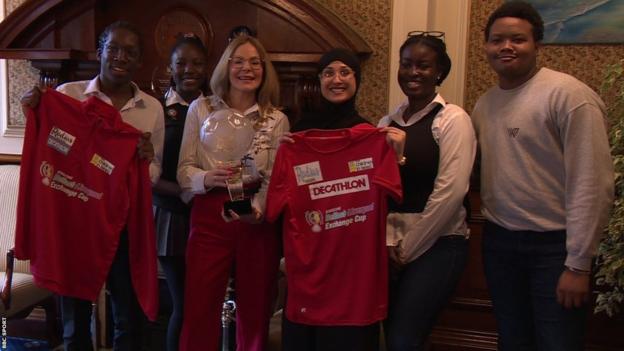 Belfast Lord Mayor Tina Black is supporting the campaign to allow asylum seekers to be able to play professional sport in a volunteering capacity
"I think the campaign name 'deserve to play' says it all. We are losing out on so much talent."
Seeing youngsters denied sporting outlets and potential future ambitions pains Adekanmi Abayomi.
Ten years on from his arrival in Northern Ireland, the Nigerian asylum seeker is still waiting for a final outcome to his plea for refugee status along with his wife and three children.
So he knows all about being stuck in this legal limbo and in his role as the founder of the Ethnic Minorities Sports Organisation Northern Ireland [EMSONI], Adekamni is at Belfast City Hall on this particular Thursday enlisting support from Lord Mayor Tina Black in the campaign to give hope to young immigrants whose sporting ambitions are seemingly being hindered by Home Office rules.
The main event in EMSONI's calendar is the Northern Ireland Confederations Cup which sees football teams made up of immigrants and other local clubs battling for glory every summer.
The Ghana team won last last year's tournament and along with Adekamni they travelled to Liverpool earlier this month to play a match against the winners of a similar competition as part of EMSONI's UK-wide campaign to publicise asylum seekers' difficulties in being allowed to play professional sport in even a non-paid capacity.
Distinction between refugees and asylum seekers
Immigrants who have been granted refugee status in the UK following successful asylum claims have the right to work, which includes competing in professional sport.
However, it's much more complicated for those talented sportspeople whose asylum applications remain outstanding.
The Home Office says that it does encourage asylum seekers to undertake volunteering activities as long as it does not amount to unpaid work - and many do in organisations such as the National Health Service - but Abayomi says the small print in the rules is making it virtually impossible for asylum seekers to follow their professional sporting dreams.
A Home Office spokesperson told BBC Sport Northern Ireland: "We are committed to ensuring asylum claims are considered without unnecessary delay but some cases can be more complex and take longer to process.
"There is nothing preventing asylum seekers from playing sport on an unpaid basis."
Adekanmi Abayomi, however, insists that the situation is not as simple as the Home Office maintains.
"Part 11B of the immigration rules permits asylum seekers to apply for permission to work if they have not received an initial decision on their claim within 12 months but this will only be considered if that delay was through no fault of the applicant," says the EMSONI founder.
"If such an application is successful, the asylum seeker will only be permitted to work in areas under the Shortage Occupation List published by the Home Office and obviously sport is not included in this list. By implication, this restricts them on where they can work.
"Volunteering for asylum seekers is technically encouraged for a charity, civic or public sector organisation but volunteering for commercial companies, like elite sport clubs, could be considered as work and the necessary paperwork must be in place," adds Abayomi.
"For an asylum seeker to participate in an elite sport, either as a player or coach, they need a certificate of sponsorship from an elite sport club with a job offer that will enable them to apply for leave to remain in the UK.
"Without the leave to remain, the appropriate sport governing body would not be able to register such asylum seeker to play professionally.
"The only route for asylum seekers to participate in sport professionally is for the Home Office to introduce a framework that allows asylum seekers to participate in elite sport as volunteers and include sport into the Shortage Occupation List because there is a short supply of developed sportspersons within the UK and loads of talent wasting away in the asylum system."
'A sportsperson's career is short'
The EMSONI chair adds that the intrinsic shortness of most sporting careers means that there must be a relaxation in the rules to allow asylum seekers to play professional sport while their claims for refugee status are still pending.
"The road is is too long for these young people because they don't have the time to be patient. A sportsperson's career is short," continues Adekanmi.
"When you have been deprived of that kind of participation, it has a lot of effects on their mental health. It has a lot of effects on their society and their parents and society generally and as a country, it has an effect on us all because we are wasting talent."
'I was depressed and ended up in hospital'
One such talent is 15-year-old Algeria native Asma Chendali whose love for basketball is matched by her ability but has seen her hopes of a career in the semi-professional game in Ireland hindered by the Home Office policy.
"I actually wasn't allowed to play to the professional level that I was told I was capable of because I was an asylum seeker," says Asma, who along with her family, was finally granted refugee status recently after an eight-year wait.
"It was heart-breaking for me and I was having problems in school and I ended up being very depressed. I ended up being in a hospital for a few months. It felt like my world had ended."
While Asma's refugee status means she is is now eligible to play in the Women's Super League in Ireland or in the UK, she fears that the "lost years" could mean that it is already too late.
"Now that I am actually trying to be able to play, my physical health isn't the best because I wasn't training like everyone else.
"I kind of stopped because 'what was the point?' so now, I literally can't do what I've always wanted to do."
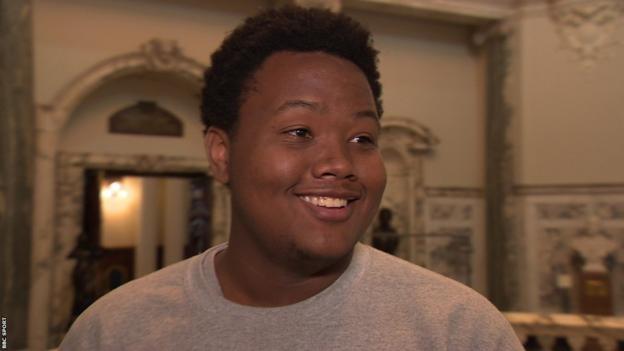 Namibian Given Hindjou is seeking asylum after arriving in Northern Ireland 11 months ago and has ambitions of a sporting career in either basketball or rugby
Given Hindjou, an 18-year-old Namibian who arrived in Northern Ireland 11 months ago, also has a love of basketball in addition to having ambitions of forging a rugby career.
"I am busy trying to hone my skills and going to the gym constantly but it's not that much help because you're not working with a ball," says Given.
"I'm slowly forgetting how to play and how to grow within the sport as well.
"I would love to play even if we are not playing for money. We just want to have fun and grow our skills."
'We can't limit the campaign to Northern Ireland'
Adekanmi, whose work for the organisation that he founded led to him being named BBC Sport NI's Unsung Hero in 2020 awarded for outstanding contribution to grassroots sport, says that Given, Asma and many others "need to be liberated and allowed the opportunity to participate like other young people".
"We are very grateful for the support we are receiving for our campaign from BBC Children In Need and we are going to be working with a lot of strategic people in the community throughout the UK to make sure we put this message in the right place," adds the EMSONI founder.
Hence last weekend's football match in Liverpool.
"This policy affects asylum seekers all over the UK so we can't limit that campaign to Northern Ireland," continues Adekanmi, whose asylum seeker status means he cannot coach even though he has just completed a Uefa Diploma C course run by the Irish Football Association.
"We have other young people, who because of injury, want to switch into coaching but they cannot do that because of the Home Office rules.
"We are working with professional clubs including Linfield and Crusaders in Northern Ireland and Everton in England because these rules are affecting them.
"The clubs want performance but they cannot tap into the talent among the asylum seekers.
"The professional clubs are also going to be beneficiaries of this campaign by the time it is achieved."

 English (US) ·