
 10 months ago
68
10 months ago
68
ARTICLE AD BOX

 Getty Images
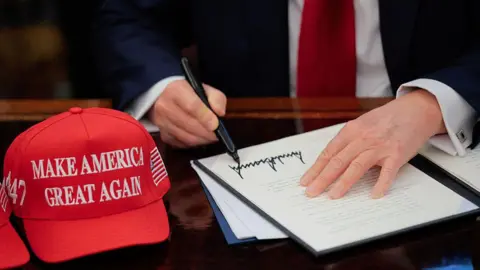
Since returning to office in January, US President Donald Trump has introduced a series of import taxes on goods from other countries, and threatened many more.
He argues that these tariffs will boost American manufacturing and protect jobs.
However, his volatile international trade policy has thrown the world economy into chaos, and critics have warned that the tariffs are making products more expensive for US consumers.
What are tariffs and how do they work?
Tariffs are taxes charged on goods bought from other countries.
Typically, they are a percentage of a product's value.
A 10% tariff means a $10 product has a $1 tax on top - taking the total cost to the importer $11 (£8.35).
Companies that bring foreign goods into the US have to pay the tax to the government.
They may pass some or all of the extra cost on to customers. Firms may also decide to import fewer goods.
At the end of May, a US trade court ruled that Trump did not have the authority to impose some of the tariffs he has announced, because he did so under national emergency powers.
But the following day, an appeals court said the relevant taxes could stay in place while the case continued.
Why is Trump using tariffs?
Trump says tariffs will encourage US consumers to buy more American-made goods, increase the amount of tax raised and boost investment.
He wants to reduce the gap between the value of goods the US buys from other countries and those it sells to them - known as the trade deficit. He argues that America has been taken advantage of by "cheaters", and "pillaged" by foreigners.
The president has announced a number of tariffs against specific goods, and also on imports from specific countries.
Many of these were subsequently amended, delayed or cancelled altogether.
Critics accuse Trump of making dramatic and sometimes contradictory policy statements as a negotiating tactic to encourage trade partners to agree a variety of political deals that benefit the US.
Trump has made other demands alongside the tariffs.
When he set out the first tariffs of his current term against China, Mexico and Canada, he said all three countries must do more to stop migrants and illegal drugs reaching the US.
Separately, on 14 July, Trump threatened to introduce severe tariffs targeting companies trading with Russia, if a deal to end the war in Ukraine was not reached within 50 days.
Which tariffs has the US put in place on specfic goods?
 Reuters
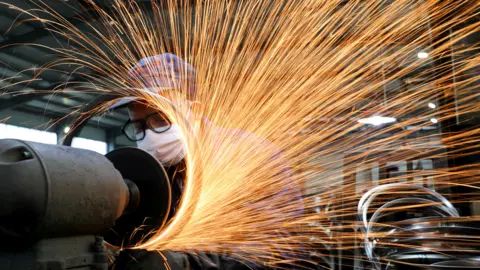
The US is the biggest importer of steel in the world after the EU, with most coming from Canada, Brazil, Mexico and South Korea
Which tariffs has the US put in place against individual countries?
Some of the first tariffs targeting China, Canada and Mexico were subsequently amended, increased and/or postponed.
On 2 April, Trump announced that a so-called "baseline tariff" of 10% would apply to all other imports from all countries.
He said goods from about 60 other trade partners which the White House described as the "worst offenders" - including the EU and China - would face higher rates, as payback for unfair trade policies.
These "reciprocal" tariffs were subsequently postponed for 90 days to allow time to negotiate individual trade deals. The initial 9 July deadline was extended until 1 August.
On 7 July, Trump warned 14 countries they faced significantly higher tariffs from 1 August if they failed to agree deals, including:
- 50% tariffs on Brazilian goods
- 35% tariffs on Cambodian goods
- 35% tariffs on all Canadian goods in addition to existing duties - but not including products covered by the existing North American free trade agreement between Canada, the US and Mexico
- 30% tariffs on all Mexican goods, or a higher rate to match any retaliatory duties on US imports - again, excluding products which meet the terms of the existing North American free trade framework
- 30% tariffs on Sri Lankan goods
 Getty Images
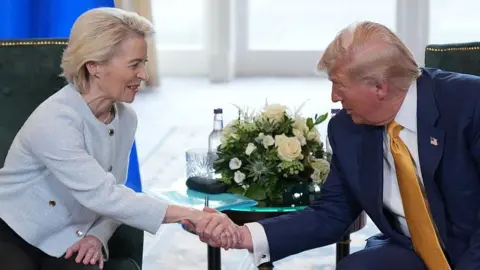
Trump said the agreement with European Commission President Ursula von der Leyen was "the biggest deal ever made"
What have the UK and US agreed on tariffs?
 Reuters
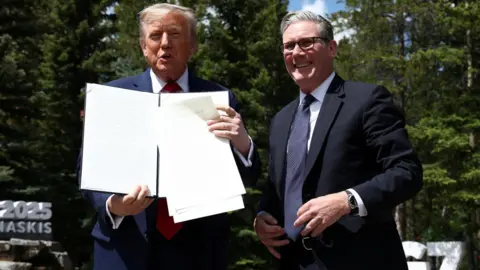
At 10%, the UK has negotiated the lowest US tariff rate so far.
The UK exported about £58bn of goods to the US in 2024, mainly cars, machinery and pharmaceuticals.
The 10% rate applies to the first 100,000 UK vehicles exported to the US every year, which is roughly the number of cars sold in 2024. Each vehicle above the quota would face the standard 25% car tariff.
The agreement also lets each country sell beef to the other. Government officials insist this does not mean any change to the UK's more stringent food safety standards.
Some US ethanol will face 0% tariffs, compared to the previous rate of 19%.
The two countries agreed an initial framework in May. Trump announced "the deal was done" at the G7 summit in Canada in June.
However, he did not confirm the expected removal of charges on steel imports from the UK which was outlined in May. Although the UK is the only country which does not have to pay 50% tariffs on steel and aluminium, a 25% tariff remains.
How has the global economy responded to Trump's tariffs?
Trump's various announcements have caused volatility on global stock markets, where firms sell shares in their business. However markets have recently been more stable.
Many people are affected by stock market price changes, even if they don't invest in shares directly, because of the knock-on effect on pensions, jobs and interest rates.
The value of the US dollar, usually considered a safe asset, has also fallen sharply at times.
The International Monetary Fund (IMF) and the influential Organization for Economic Co-operation and Development (OECD) both downgraded their predictions for global economic growth in 2025 as a result of the tariffs.
Both organisations expect the US economy to be badly affected.
As Trump marked 100 days in power in May, the commerce department said the US economy shrank in the first three months of 2025, after strong growth in the last quarter of 2024.
The president insists his trade policy is working, but influential voices within his own Republican Party have joined opposition Democrats and foreign leaders in attacking the measures.
Are prices going up for US consumers?
Analysts say tariffs are already feeding into the overall US inflation rate, as businesses pass on some or all of their higher costs.
Prices rose by 2.7% in the year to June, up from 2.4% the previous month reflecting increases in items including clothing, coffee, toys and appliances.
Adidas and Barbie maker Mattel are among the global firms planning to charge American customers more.
Some companies are also importing fewer foreign goods, which can make those which are available more expensive.
The costs of goods manufactured in the US using imported components are also expected to rise.
For example, car parts typically cross the US, Mexican and Canadian borders multiple times before a vehicle is completely assembled.
The new tariffs have also resulted in tighter customs checks at the US border, leading to delays at the border.




 English (US) ·