
 3 months ago
67
3 months ago
67
ARTICLE AD BOX
Mark SavageMusic correspondent

 Rhino Music
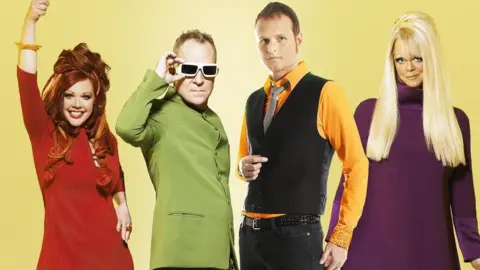
The B-52s' quirky, danceable pop proved to be hugely influential
If you see a faded sign at the side of the road that says, "15 miles to the Love Shack," you know you're in for a good time.
The B-52s biggest hit, released in 1989, is one of pop's most carefree and irreverent songs, full of manic energy and endlessly quotable lyrics.
It was inspired by singer Katie Pierson's own house, just outside Athens, Georgia, where the band had created cult classics like Rock Lobster and Private Idaho.
"It was a little tenant farmer's house and it really was a love shack," she says. "It had a wood stove and no running water and a tin roof, rusted. It was a funky little shack."
As immortalised in the song, Pierson's ramshackle hideout hosted some wild parties, before it perished in flames in 2004.
But these days, the singer has her sights set on something altogether more grand. The B-52s are heading to the UK in June, as part of their ever-extending farewell tour, and Pierson is using the trip as an excuse to indulge her fascination with British heraldry.
"I'm such an Anglophile," she says. "My wife Monica and I have Britbox, so we watch all the British dramas and drink tea.
"I hate to say it, because it's such a tourist cliché, but I really want to visit Downton Abbey."
But after binge-watching Inspector Morse, she's crossed one city off her itinerary.
"I'm not going to Oxford," she laughs. "They have multiple murders there, every day. How is that possible?"
 Getty Images
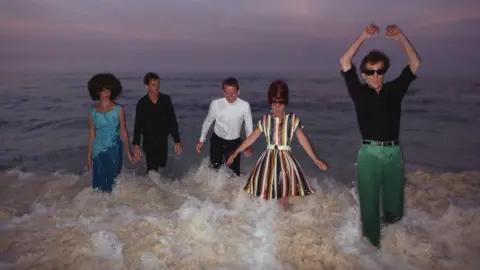
The B-52s go lobster hunting in 1982: (L-R) Cindy Wilson, Keith Strickland, Ricky Wilson, Kate Pierson and Fred Schneider
The B-52s will hit British shores (and stately homes) in June, co-headlining a tour with fellow new wave band Devo. Fifty years after they first formed, they're playing arenas for the first time, including two nights at Manchester's AO Arena and a headline show at The O2 in London.
It's a sign of how a weird, underground act that sang about aliens and jellyfish have become extraordinarily influential proponents of queer culture and alternative rock.
It all started, recalls Pierson, in Hunan's Chinese Restaurant on Baxter Street in Athens.
"We couldn't afford food, so we got a drink. It was one of those crazy cocktails called a Flaming Volcano, and it was actually on fire," she says.
Emboldened by the fishbowl of alcohol, someone suggested the idea of forming a band.
"There were six of us there," says Pierson, "the band members and our friend Owen Scott, and we went to his house to jam.
"He went upstairs to write a paper - he's a clinical psychologist now – and we wrote a song.
"So it started with that flame. It was like spontaneous combustion."
The song was called Killer B's, inspired by stories of deadly insects invading the US from Brazil.
"It has a buzzing sound in the chorus, very avant garde," says Pierson. "We have a recording of it, but it was never finished."
At that point, the band consisted of Keith Strickland on guitar, Ricky Wilson on congas, and Pierson, Cindy Wilson and Fred Schneider on vocals.
The set-up changed a little - with Wilson taking over guitar duties - but their free-wheeling, anything goes approach was set in stone.
"Most of the songs were written by jamming," confirms Pierson. "We had a tape player and we'd record ourselves, then pick out the parts and put them together in a collage style.
"Agreeing which ones to keep is really hard work but we were never at a loss for good parts."
 Getty Images
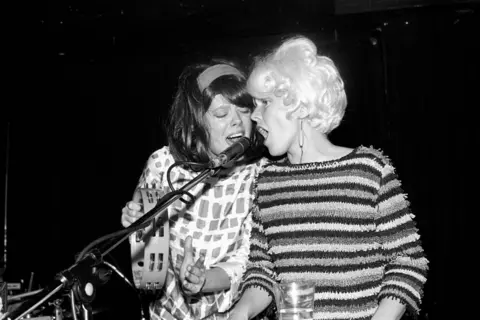
The band crafted their sound from what they called "the freedom zone" - long, improvised jams that were recorded and edited into party-starting anthems
Taking cues from surf rock, 60s pop and sci-fi soundtracks, The B-52s sound is laced with exuberant humour and a love of junk culture.
Driving it forward is Schneider's manic drawl (imagine Matthew McConaughey operating a fairground ride) and Pierson and Wilson's shimmering harmonies.
The band made their live debut at a house party on Valentine's Day 1977, decorating the walls with Barbie dolls and dressing in thrift store wigs.
"We only had stereo speakers, but the house shook because our friends were dancing so hard," says Pierson.
The five-song set went down so well, they played it twice and, as their reputation grew, a local record store owner offered to release their first single, Rock Lobster.
A cartoon maritime odyssey, powered by what Ricky Wilson called "the stupidest riff you ever heard", it became one of the first independent hits on the American new wave scene, selling more than 20,000 copies.
Before long, the band was playing in New York, rubbing shoulders with Patti Smith, Talking Heads and Blondie at CBGBs and shaking punks out of their contemptuous indifference.
"Everyone who was sort of leather jacketed, leaning against the wall, too cool to dance, started dancing," recalls Pierson.
Even John Lennon was a fan – famously telling Rolling Stone that Rock Lobster inspired his return to music after a five year hiatus.
"I said to meself, 'It's time to get out the old ax and wake the wife up!'"
Not everyone was swept away by the B-52s shell-arious shenanigans, though.
"A lot of people thought we were weird," admits Pierson. "They assumed we were from England, or that Cindy and I were drag queens.
"But we were definitely a breath of fresh air, even in the punk scene."
 Getty Images
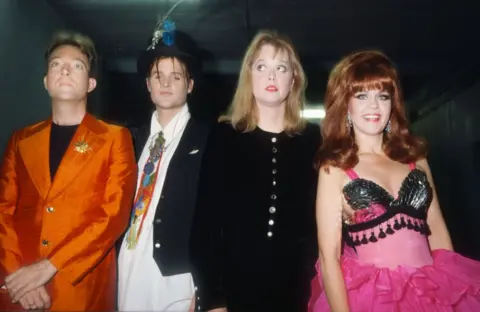
The band's career took a definitive turn with the multi million-selling Cosmic Thing in 1989
Signed to Island Records, they recorded their debut album in the Bahamas, with producer Chris Blackwell capturing the stripped-back immediacy of their concerts – where Ricky would remove his guitar's middle strings to create a rougher sound.
"We were so disappointed when we heard the record. We were like, 'Oh, we wanted it to sound bigger and more full'.
"But it was a genius choice, because we sounded so different, I think, with Fred's way of singing and our harmonies and the unusual lyrics."
A re-recorded Rock Lobster became a minor hit, followed by similarly danceable, subtly transgressive, B-movie party classics like Dance This Mess Around, Give Me Back My Man and Mesopotamia.
But in 1983, Ricky Wilson fell ill with Aids. He kept the diagnosis secret from everyone but Strickland, eventually succumbing to the disease in October 1985.
The band had just completed their fourth album, Bouncing Off The Satellites but, devastated, they couldn't face promoting it.
"There was some expectation that we'd get another guitar player and just get out there and tour, but we couldn't. We couldn't do that. We were just stunned and grief stricken."
Without their master strategist and chief songwriter, it seemed like the B-52s were over. In a 1990 Rolling Stone article, Schneider admitted: "We were just barely staying afloat, living off our catalogue".
The band broke into pension funds and downsized houses to make ends meet.
Strickland moved out of Manhattan and rented a cabin in Woodstock, across a pond from Pierson, who would canoe over to see him every morning.
"One day he said, 'Oh, I've got some music I've been working on', and it sounded amazing.
"When he played it for the rest of the band, everyone just got excited. It was so healing to start writing music together again."
The result was 1989's Cosmic Thing, which produced two giant radio hits - Love Shack and Roam.
Much of the album is a nostalgic tribute to Ricky, recalling the places and spaces they'd shared in Athens.
Recorded in the midst of the Aids crisis, and with the majority of the band in the LGBTQ community, it's defiantly upbeat, finding a way to smile through grief.
Pierson notes that the songs were more "linear and traditional" than the scattergun silliness of their earlier work.
"When we did Love Shack, for example, I realised we had to repeat that chorus."
 Getty Images
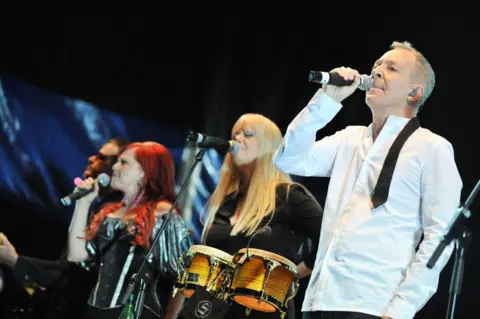
The band hit the UK in June for their Cosmic De-Evolution Tour, which is subtitled "One last orbit (Maybe?)"
Cosmic Thing put them on a new level, selling more than four million copies and earning two Grammy nominations.
"It was unexpected," Pierson admits.
"When we got back together, it wasn't an attempt to create hits. We were doing it for ourselves. And I think that's why it [the success] all happened. It was really genuine and heartfelt."
With pop immortality ensured, the band cameo'd in the 1994 Flintstones movie. ("Fred and I got to ride in one of those cars where you push it with your feet. It was just a blast.") and released two more albums, 1992's Good Thing and 2008's Funplex.
They announced their "final tour ever on Planet Earth" in 2022, but kept coming back for more. This April, they'll play a Las Vegas residency (their seventh) before jetting over to Europe.
Which begs the question: When Pierson chose her first beehive wig in 1976, did she realise it would become her signature look for the next five decades?
"When we picked those out, we weren't aiming to look glamorous at all," she says, "but dressing up was a way to feel like you'd transformed on stage.
"You don't get as nervous if you dress up and wear a wig. You should try it sometime."
Advice taken. We'll see you in a powdered headpiece somewhere near Highclere Castle this June.

 English (US) ·