
 4 months ago
86
4 months ago
86
ARTICLE AD BOX
Danielle KayeBusiness reporter

 Danielle Kaye
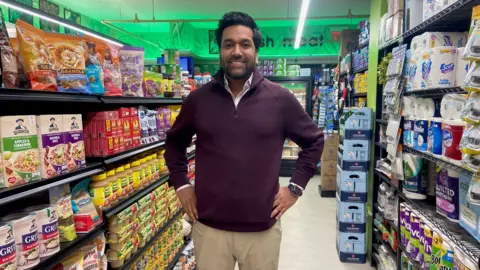
Alap Vora owns Concord Market in Brooklyn, New York
Walking through the aisles of his grocery store in Brooklyn, New York, Alap Vora points to a box of breakfast cereal.
He says he paid roughly $5 (£3.75) to his distributor to get the pack of Honey Bunches of Oats onto the shelf.
But his much larger rivals, the big US supermarket chains, can sell that same box for around $5 - essentially, the price he has to pay wholesale.
That dynamic makes it "impossible for us to compete", says Vora, 40, who opened Concord Market, nestled on a busy Brooklyn intersection, in 2009.
"Some of our competitors, obviously the larger chains and the larger big-box stores - they have direct relationships with manufacturers. They have preferred pricing," Vora says.
"That's where it becomes challenging [for us]."
Similar pressures are felt by independent grocery stores across the US. There are more than 21,000 such shops in the country, and they account for one third of grocery sales.
Vora decided to speak out about the pricing issue in a particularly high-profile forum - testifying before the US Senate two years ago.
He was able to do this thanks to connections he had maintained with US small business organisations, from his time studying business in Washington DC.
As a college educated US-born citizen, Vora says he felt comfortable using his voice to raise awareness about the pricing pressures that are putting a strain small business owners.
"I just felt like it was my responsibility to speak on behalf of the community." His father and his uncles, who were immigrants to the US, did not feel the same level of security, he adds.
His late father had started the family business in 1971, initially as a gift shop in downtown Brooklyn, before shifting into groceries.
In his testimony before the Senate Committee on Banking, Housing and Urban Affairs in May 2024, Vora described "fluctuating, opaque pricing structures" from distributors.
"Some of our customers would rather rent a car for a day to go to larger competitors like Costco, Trader Joe's and others, because of the pressures that impact our pricing structure and ultimately our bottom line," Vora testified at the time.
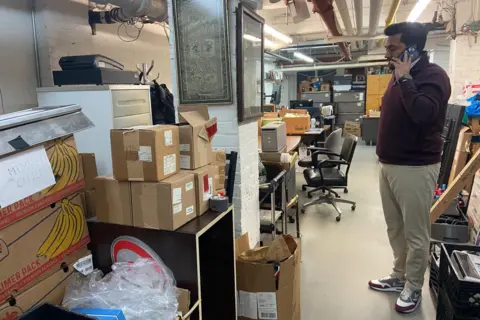
Sitting in his basement office at Concord Market nearly two years later, Vora is surrounded by boxes of packed-up items from a second grocery store in Manhattan that he had to shutter just weeks ago because of cost pressures.
He says those same issues persist. From his vantage point, little has changed since his Senate appearance.
 Danielle Kaye
Vora says that sometimes he buys things from Costco to resell, because it is still cheaper
The backdrop to this is a robust debate about the policy and regulatory solutions to help small businesses stay afloat amid rising costs.
Katherine Van Dyck, the founder of KVD Strategies, a consulting firm that advises small businesses on antitrust issues, says price discrimination is at the top of the list of issues that business owners and trade groups raise.
She says it strains not just grocery stores, but also independent bookstores, locally-owned pharmacies and a range of other business sectors.
"When a grocer is faced with those sorts of pricing dynamics in an industry that has razor-thin margins, it makes it incredibly difficult to compete - and it contributes to closures," Van Dyck says.
As a partial solution, Van Dyck points to a long-dormant law that prohibits sellers from offering preferential prices to certain buyers and not others, in order to protect smaller retailers from the dominance of larger chains.
Dubbed the Robinson-Patman Act, the 1936 Depression-era law was brought back to life at the end of former president Joe Biden's term having not been enforced for decades.
Biden administration regulators filed two lawsuits under the act - one against a major alcohol distributor and one against PepsiCo. The former is ongoing, while the latter was dismissed last year under the Trump administration.
PepsiCo said at the time that it "always and will continue to provide all customers with fair, competitive, and non-discriminatory pricing, discounts and promotional value".
While come commentators call for the robust enforcement of the Robinson-Patman Act, others say this would not benefit consumers, and would instead raise prices for shoppers.
Daniel Francis, a law professor at New York University, says other tactics, like easing the tax and regulatory burden of small retailers, would give them more support.
Francis adds that a situation in which a large retailer asks a supplier to charge its smaller rivals more would be a "huge problem" - but one that is already illegal under separate antitrust laws.
Still, Van Dyck argued there's no evidence showing harm from Robinson-Patman Act enforcement.
We asked the US Small Business Administration, the government agency responsible for supporting the sector, for a comment.
 Danielle Kaye
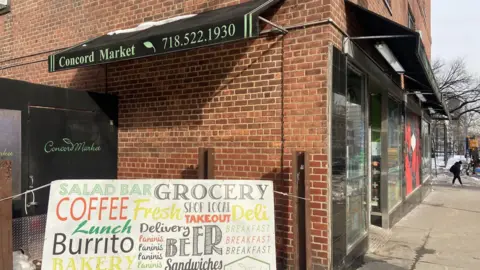
Concord Market, on a busy intersection in Brooklyn, New York, opened in 2009
Vora says he doesn't see any easy fix to help small business owners secure better prices from suppliers. There have been times when his team has gone to big chains such as Costco and CVS Pharmacy to buy items that are on promotion, "because it's cheaper than what we're buying it for".
The fact that larger chains often have direct lines of communication with manufacturers puts him at a disadvantage, he adds.
What would help, he adds, is more pricing transparency and better communication with the big brands.
He said that last year he met with representatives from PepsiCo and its snack food subsidiary Frito-Lay, but only after struggling to find the right person to talk to.
"I can only imagine how difficult it is for somebody else who may not have the time or the system or the structure that I do to make those calls."
He adds: "It has to be a decision by society. Is small business critical? Is it important to have job creation at the small business level?
"It those things are critical, there needs to be more support for them."
Read more US small business stories






 English (US) ·