
 4 months ago
77
4 months ago
77
ARTICLE AD BOX
Jonathan JosephsBusiness reporter

 BBC
BBC
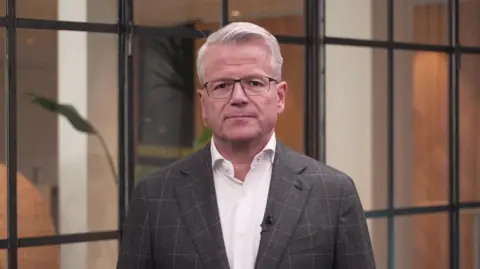
Maersk chief executive Vincent Clerc spoke to the BBC
The US, Israel and Iran must come to "some kind of deal" to restore global trade routes in the Middle East, the boss of Danish shipping giant Maersk has said.
Vincent Clerc told the BBC that "ultimately we need to get back to something where freedom of navigation and peaceful navigation is restored".
The war between Iran and Israel and the US has brought two vital shipping routes to an almost complete standstill and caused widespread disruption to the global economy.
"The main concern is the safety of our crews, is the safety of our assets," Clerc said in the exclusive interview.
He said that as long as the significant threat of drone strikes remains, with no guarantee of a truce between the two sides, "it is very hard for us to put our colleagues and our ship in harm's way".
According to the UN's International Maritime Organization (IMO) at least seven seafarers have been killed in the Strait of Hormuz since the conflict began, with several others injured.
In a speech to an IMO committee on Monday, secretary general Arsenio Dominguez said: "These seafarers are simply carrying out their duties and performing an essential service to the global community, ensuring the continued flow of goods and energy, and they must be protected from the consequences of broader geopolitical tensions."
Iranian government spokesperson Fatemeh Mohajerani justified the blockade by saying the country needed to maximise "all resources", including the Strait of Hormuz, whilst in a state of war.
Before the conflict, around a fifth of global oil supplies travelled through the Strait of Hormuz which is effectively closed because of Iran's threats to target shipping.
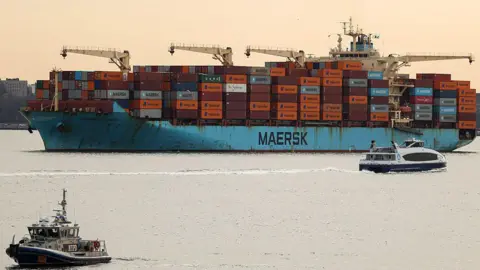
At the same time, the world's biggest shipping lines are also avoiding passage through the Red Sea because of the security threats.
 Getty Images
The higher cost of longer voyages around the Cape of Good Hope and higher oil prices means that shipping is becoming more expensive, adding to upward inflationary pressures, Clerc said.
"We have traditional contracting mechanisms that pass on this fuel fluctuation, whether they go up or they go down, onto the customers. So what it means is that ultimately, in this case, these increases will pass to our customers and will pass on to the consumers."
The extra costs work out at around $200 for a standard 20ft shipping container, which mean "anything from a 15% to a 20% increase on some of the freight cost", Clerc said.
Maersk's rivals MSC and Hapag-Lloyd have also increased charges because of the Iran linked interruptions to their services.
He said the disruption caused by the war has had a "profound impact" on Maersk, the world's second biggest shipping company, with many customers not receiving regular deliveries when they were expecting them.
Clerc warned this is "extremely disruptive" in a region that is heavily reliant on imported food.
It means there are a lot of logistical challenges to "keep the food moving" and make sure that it "continues to be on the shelves of supermarkets" rather than going to waste as it sits on ships or in ports.
Asked if he was concerned about product shortages, he said "we've seen a fantastic reaction" with land bridges and trucks trying to keep things moving.
However, it is hard to move the same volume by land as by sea and Clerc said that whilst there was enough capacity to keep the most important goods moving a lot of exports like petrochemicals are "going to have to take the back seat for a while".
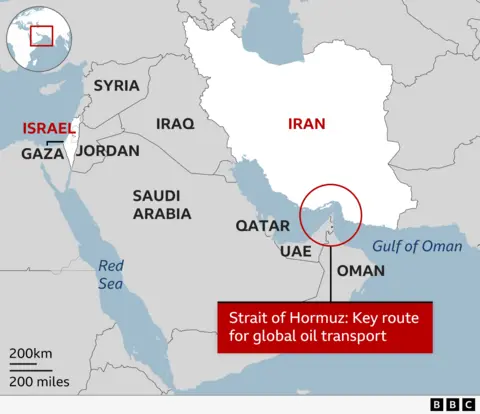
Map of Strait of Hormuz
Governments including the United States and France have suggested that naval escorts could be a way to open the waterways again.
The Maersk boss said that "effective" protection could be "at least a temporary reprieve" to get ships moving again but stressed he wasn't willing to put staff at risk.
It appears to be something that would be welcomed by global energy markets and bring relief to the global economy.
When US energy secretary Chris Wright posted on social media that the US navy had successfully escorted an oil tanker through the Strait of Hormuz, oil prices fell sharply.
However, they rose again when the post disappeared and the White House said no tankers had been escorted out of the strait.
It was only a few weeks ago that major shipping lines including Maersk started a phased return to the Red Sea route.
Threats of Houthi attacks on ships linked to the Hamas-Israel conflict led them to stop using the passage for two years.
Any ships either there or in the Strait of Hormuz remain vulnerable amid current tensions.
Data from the logistics firm KN Seaexplorer suggests 132 ships remained stuck in the Gulf as of Monday.
The exact number is hard to confirm amid reports that some vessels have turned off their transponders to hide their locations.
"You're very close from the Iranian coastline, so you don't have a lot of time to react, so you would need a significant presence from the Navy to be able to provide a shield all the way through," Clerc said.
"I have personally a hard time seeing though that this is the permanent solution to the situation because the traffic is very important [and] the Strait is very narrow".
Ultimately he thinks that a "some kind of deal" is the only way to restore the freedom of the seas that the health of the global economy relies on.







 English (US) ·